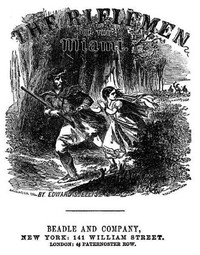
The Riflemen of the Miami — Edition Insights
Edition facts
Before opening The Riflemen of the Miami — Edition Insights, the edition data offers a quick orientation: 44,733 words, 3 hr 15 min estimated reading time, and 6 detected text sections.
The text analysis averages about 18.7 words per sentence, while the detected sections provide another way to judge how the source is divided.
Project Gutenberg metadata also associates the work with “Indians of North America -- Fiction,” connecting these edition facts with the source record’s subject description.
Calculated from edition completeness, EPUB availability, text structure and catalogue metadata. Not a user rating.
How this score is calculated
- Description quality20 pts
- Title & short description10 pts
- Source metadata20 pts
- Text length15 pts
- Chapters / structure15 pts
- EPUB file integrity20 pts
Total of 100 points, scaled to a 2.5-5.0 range. Editions with an empty description or a missing EPUB file are not scored.
Read the Text
If it were done, when 'tis done, then 'twere well It were done quickly.--MACBETH.
"Quick, boys, and be careful that they don't see your heads."
Four men were moving along under the bank of the Miami, with their bodies bent, at a gait that was almost rapid enough to be called a run. They were constantly raising their heads and peering over the bank, as though watching something in the wood, which in this section was quite open. All four were attired in the garb of hunters, and were evidently men whose homes were in the great wilderness. They had embrowned faces, and sinewy limbs, and the _personnel_ of the woodman--of the men who hovered only upon the confines of civilization, rarely, if ever, venturing within the crowded city or village. It is hardly necessary to say that each carried his rifle and his hunting-knife.
Between the three foremost was a striking resemblance; it appeared impossible that more than five years divided them in age. Two were brothers, George and Lewis Dernor, while the third answered to the _sobriquet_ of Dick--his real name being Richard Allmat. The fourth--he who brought up the rear--possessed an individuality which must have marked him in any situation. Barely more than five feet in height, and with bowed legs, instead of owning a jovial temper, as one would have a right to expect from his jolly-looking face, he was, in reality, a most irascible fellow. Never known to express satisfaction at any occurrence, gift or suggestion, he was constantly finding fault, and threatening dire vengeance upon those who surrounded him. These threats never being carried out, attracted little attention. "Tom" (as he was called) was considered a privileged individual, and, in spite of his disposition, was a favorite with those who knew him. This may seem strange when we add that, in addition to his sour temper, the natural defect of his legs prevented him from placing any dependence upon them. At his best speed he was but an ordinary runner. A stranger well might wonder that he should adopt a life where fleetness of foot was so necessary--in fact, so almost indispensable. Tom O'Hara turned ranger from pure love for the wild, adventurous life; and, despite the natural defects to which we have referred, possessed accomplishments that rendered him a most valuable ally and companion. He never had met his superior with the rifle, and his knowledge of woodcraft was such that, although he had spent ten years on the border, his slowness of foot had never operated against him; nor once had he been outwitted by the red-men of the woods. Besides this, he had the enviable reputation of being a _lucky individual_--one whose rifle never missed fire, or sped wide of its mark--one to whom no unfortunate accident over occurred; so that, take him all in all, few hunters were safer in the wood than this same Tom O'Hara.
These four were known as the _Riflemen of the Miami_, of whom Lewis Dernor was the leader. Another member, then a long way off, will be referred to hereafter.
"Quick, boys, and be careful that they don't see your heads," admonished Lewis, ducking his own and gesticulating to those behind him. "_Sh!_ look quick! there they go!"
The four stretched their necks, glancing over the bank, out into a small clearing in the wood.
"They'll cross that in a minute," whispered the first speaker. "Don't raise your heads too high or you'll be seen."
"You don't appear to think nobody knows nothing but you," growled Tom, with a savage look.
"_Quiet!_ There they go!"
One Indian strode into the clearing, followed by another, then by two abreast, between whom a woman was walking, her head bent as if in despair, with steps painful and labored. Behind these came three other savages. They passed across the clearing--the whole seven, with their captive like the moving figures in a panorama, and entered the wood upon the opposite side.
"Every mother's son of them is in his war-paint," said Lewis--who, by the way, divided his words with Tom, the other two rarely speaking except when directly appealed to.
"Who said they wasn't?" demanded Tom. "And what difference does it make? They've got somebody's gal there, hain't they? eh? Say. And what's the odds whether they've daubed themselves up with their stuff or not?"
"Well, what's the next move? To set up a yell and pitch after them?"
"None but a fool would want to do that."
"But don't you notice the bank gets so low down yonder that it won't hide us, and we'll have to show ourselves?"
"It'll hide us as long as we want to be hid. Come, don't squat here, or we'll let the rascals slip, after all."
Again the three moved down the bank, as rapidly, silently and cautiously as spirits, ever and anon raising their heads as they gained a glimpse of the Indians passing through the wood. The latter were following a course parallel with the Miami, so that the relative distance between the two parties remained nearly the same. It was manifest to the hunters that the Indians intended crossing the river with their captive at some point lower down, and were making toward that point. It was further evident from the deliberation in their movements, and from the fact that they were not proceeding in "Indian file," that as yet they had no suspicion of being pursued, although every one of their number knew of the existence of the Riflemen of the Miami--that formidable confederation whose very name was a word of terror even to their savage hearts. Entirely unsuspicious of the danger which menaced them, every thing was in favor of the hunters.
For several hundred yards further, the two parties maintained their relative distance, the Indians proceeding at a usual walk, and the whites at a very irregular one--now running rapidly a few steps, and then halting and gazing over the bank to ascertain the precise whereabouts of their enemies; then skulking a few yards further, and halting as before, remaining all the time nearly opposite the "braves." Suddenly the latter came to a stand.
"Now for a confab," said Lewis, as his companions gathered about him. "I wonder what they are going to jabber about?"
"What do you want to know for, eh?" asked Tom.
"It's pretty plain they're going to cross the river, but, confound it, how can we tell where it's going to be done? I've told you that the bank gets so low, just yonder, that it won't hide us any longer."
"Who wants it to hide us? They intend to cross the river _here_, and in about ten minutes, too. Just watch their actions, if you can do it without showing your head."
The Indians stood together, conversing upon some point about which there seemed a variance of opinion. Their deep, guttural, ejaculatory words were plainly audible to the hunters, and their gleaming, bedaubed visages were seen in all their hideous repulsiveness. They gesticulated continually, pointing behind them in the direction of their trail, and across the river, over the heads of the crouching Riflemen, who were watching every motion. Nothing would have been easier for the latter than to have sent four of these savages into eternity without a moment's warning; yet, nothing was further from their intentions, for, of all things, this would have been the surest to defeat their chief object. The captive would have been brained the instant the savages saw they could not hold her. The great point was to surprise them so suddenly and completely as to prevent this.
From the present appearance of matters, this seemed not very difficult of accomplishment, as it was a foregone conclusion upon the part of the hunters that the savages would endeavor to ford the river at the point where they lay in ambush for them. It only remained for the Riflemen to bide their time, and, at the proper moment, rush upon and scatter them, and rescue the captive from their hands.
"I wonder whether they're going to talk all day," remarked Tom, impatiently, after they had conversed some twenty or thirty minutes.
"They're in a dispute about something. It won't take them long to get through with it."
"How do you know that, I should like to know? Like enough they'll talk till dark, and keep us waiting. Confound 'em, what's the use?"
No one ventured to reply to Tom's sulky observation, and, after several impatient exclamations, he added:
"The longer they talk the louder they get, which is a sure sign the dispute is getting hotter, which is another sign it'll be considerable time before they get through."
"I am sure we can wait as long as they can," said Dick, mildly.
"My heavens! who said we couldn't? Just hear 'em jabber!"
The conversation of the Indians had now become so earnest, that every word spoken was distinctly heard by the Riflemen. The latter, from the dress and actions of the savages, understood they had no chief with them, but were merely seven warriors, who had been out on this barbarous expedition, and were returning to their town with the booty and the captive they had secured.
"They're talking in the Shawnee tongue," said Lewis. "Can't you understand what they're driving at?"
"If you only keep your jaws shut a minute or two, I could; but if you three fellers mean to talk all the time, I should like to know how I am going to understand any thing they say. See whether you can keep quiet a minute, just."
Tom's companions did as requested, while he bent his head forward, and seemed to concentrate all his faculties into the one of listening. Upon the part of the Riflemen all was still as death. After several minutes of the acutest attention, Tom raised his head, and said, with a glowing expression:
"They're talking about _us_."
"The deuce! what are they saying?"
"Don't you see they're pointing up the river and across it? Well, the meaning of all that is, that they're wondering which way we'll come from."
"What seems to be the general expectation?"
"The trouble is just there--the expectation is altogether too general. Some think we're on their trail, others that we're following the other side the river down, and waiting for the chance to let drive at 'em, while one, at least, feels certain we're _coming up_ the stream to meet 'em."
"Is that their dispute?"
"A part of it, of course, but the trouble is--what to do. Some want to strike off in the woods and take a roundabout way to reach home; but the greatest number want to cross the stream at this point."
"They'll probably do it then."
"Of course they will--no; I'll be shot if they ain't going further into the woods!" suddenly exclaimed Tom.
"They're going to start in a minute, too. Get ready, boys, for a rush--it's all we can do."
"Hold still a minute," commanded Tom, excitedly.
Then dropping his rifle, he ran down to the river's edge, and picked up several large pebbles, one of which he placed in his right hand as if about to throw it.
"What are you going to do with that?" asked Dick.
"That's none of your business; you've only to wait and see. Just keep your heads down now, if you don't want them knocked off."
Tom, drawing his hand back, struck it quickly against his thigh, accomplishing what is generally termed "jerking" the stone. The latter went circling high over the heads of the disputing Indians, and came down upon the other side of them, cutting its way through the dry leaves of the trees with a peculiar _zip-zip_, which was distinctly heard by the Riflemen themselves.
The unusual sound could not fail instantly to attract the attention of the Indians. They paused in their conversation, and turned their alarmed gaze toward it, as if in expectation of some danger. With their instinctive caution, they separated, and partially protecting themselves behind the trees, prepared to receive what they supposed to be their enemies. A noticeable fact did not escape the eyes of the Riflemen. The captive, a weak, defenseless girl, was not allowed to screen herself, as did her captors, but was compelled by them to stand out in full view, as an additional safeguard against their bullets.
It was at this moment that Tom hurled the second stone over the heads of the Indians, it descending with the same sharp, cutting sound, and resolving their suspicions into a certainty that their white enemies were indeed at hand. Lewis Dernor, now that the moment of action had arrived, was as shrewd and far-sighted as either Tom or any of the others. It was these very qualities, coolness and self-reliance in the crisis of danger, that made him nominally the leader of the Riflemen of the Miami. He saw the great advantage gained by O'Hara's artifice in attracting the attention of the Indians to the point opposite to that from which the peril threatened; but, at the same time, he well knew that those same Shawnees were too well skilled in woodcraft to suffer their gaze to be diverted for any length of time from the river-bank.
As matters now stood, the captive herself was the only one who was looking in the direction of the latter, while her gaze was a mere mechanical one, wandering hither and thither without resting for a moment upon any particular object. Lewis felt that the all-important point was to make her aware of the vicinity of friends. She being a total stranger to them, and evidently with no hope of any immediate rescue, made this a matter of considerable difficulty; but, without hesitating a moment, Lewis suddenly arose to the upright position, thereby exposing his head and shoulders, and beckoned to the girl to approach him. The instant he had done this, he dropped on his face and disappeared.
The attempt was only a partial success. At the moment of rising, the gaze of the captive was toward a point further down-stream; but the figure of the hunter, as it rose and sunk from view, was in her field of vision and did not entirely escape her notice. The unusual occurrence drew her look thither, making it certain that a second attempt, could it be made, would succeed far better than the first. All this Lewis comprehended, and as quick as possible repeated his movement precisely as before.
This time the girl saw him and perfectly understood his meaning; but, with a precipitancy that filled the hunters with the greatest alarm, she started directly toward them, with outstretched arms, as if imploring assistance. It was at this instant that Lewis discovered a quickness of perception, coolness and promptness of action that was absolutely wonderful. Looking out upon the exciting drama being enacted before him, he saw with unerring certainty how far the girl could run before being fired at by the savages. Waiting until she had gone the distance, he raised his head and shoulders to view, and called out in a voice of thunder:
"I say, gal, drop flat on your face and stay there."
The quickness with which this command was obeyed, and the almost simultaneous crack of two rifles, might well have caused the belief that she had fallen because shot through the heart; but such was not the case. The command of Lewis broke upon her like a thunder-peal, and as quick as a flash of lightning did she comprehend the fearfully imminent peril in which she was placed. So marvelously close had been the calculation of the hunter, that at the very instant she obeyed him, the rifle of the nearest Indian was pointed full at her. This did not escape the eagle eye of O'Hara, who, with the same coolness that characterized the action of his leader, discharged his piece at the bronzed head of the Shawnee, his aim scarcely occupying a second. The bullet sped sure, striking the savage at the very moment his own weapon was fired, and his death-yell mingled with the whistle of his own harmless rifle-ball.
Even in this moment of terrible danger, the manner in which the Indians shifted to the opposite side of the trees could but attract the notice of the hunters. It was simultaneous on the part of all, and resembled that of automata, moved by machinery. First, every copper-colored body was exposed to full view; and the next minute six gleaming rifle-barrels only showed where they had sheltered themselves from the fire of the whites. They no longer doubted the point from which their danger threatened, and a genuine strategic Indian fight now commenced.
Had the captive, who was now literally between two fires, done nothing but merely fall upon her face, her situation could not have been improved in the least thereby. But the nature of the ground near her was such that, by lying perfectly motionless, the bullets of the Shawnees could not strike her, unless they could gain a position nearer to the hunters. As matters stood, she was safe only so long as her captors could be kept from changing their places.
This was manifest to both the whites and the Indians; and while the latter were now actuated by the desire to slay the girl, the efforts of the former were turned toward her salvation. It was further evident that the Shawnees were aware that they were now opposed to the Riflemen of the Miami, and were nothing loth for a trial of skill. The loss of one of their number was such a matter of course, that it operated only as an incentive for exertion and skill upon their part.
A portion of the dress of the girl, as she lay upon the ground, could be seen by several of the Indians, and they fired numerous shots at it. Finding this accomplished nothing, they resorted to a far more dangerous expedient--that of shooting away enough earth in front of her to allow the free passage of one of their bullets to her body. It will be seen that great skill was required to do this, but the expertness of the Shawnee marksmen was equal to the task. They commenced their work by sending a ball so as to strike the earth immediately before her, and a few inches below the surface. The instant this was done, another fired his bullet directly after, with such skill that it varied but the fraction of an inch from following directly in its path. The force with which these balls were discharged was such that the twelfth one would most assuredly take the life of the girl.
None knew this better than Lewis Dernor, who, in the same trumpet-like tone that had characterized his former command, called out:
"Young gal, clean away the dirt in front of you and hide yourself better, or the imps will riddle you."
It required no more incentive to do this, and she used her hands with such vigor that a few moments accomplished all she could wish. The ground, being soft and moist, favored her, and when she dragged herself a few feet forward, all of her dress disappeared from the view of the Indians, and she was as safe from their bullets as if behind the river-bank itself.
A few more shots convinced the Shawnees of this, and they now sent several bullets whistling over the heads of the Riflemen as if to remind them that they were to receive attention. So long as the members of the two parties maintained their respective positions, this affray could amount to nothing; accordingly, several of the savages made an effort to change their posts in such a manner as to outflank the whites. Despite the admirable skill with which this attempt was made, the deadly rifle of George Dernor brought down a warrior as he flitted from tree to tree. This, for the present, put a stop to the movement and turned the efforts of the savages in another direction.
The opening chapter of The Riflemen of the Miami establishes a brisk, physical style. Four hunters move along the riverbank, bodies bent, heads raised to scan the woods. Ellis describes their gait as “almost rapid enough to be called a run,” and immediately distinguishes the fourth man, Tom O'Hara, by his bowed legs and irascible temper—a contrast to his jolly face. The narrator notes that Tom's slowness of foot never cost him, thanks to his rifle skill and woodcraft. This early portrait signals that character traits, not just action, will drive the story.
Voice and Dialect
Ellis uses dialect to differentiate characters and inject humor. Zeke Hunt, a runaway from Pennsylvania, speaks in a whining, self-pitying register: “I'm derned 'fraid it won't be any name at all if I stay in these parts much longer.” His speech is peppered with “boo-hoo,” “gracious,” and exaggerated fears. In contrast, the hunters speak in clipped, practical sentences. Dernor asks, “How came you in these parts, my friend?”—a formal, almost courtly tone for the wilderness. The narrator also adopts a wry, knowing voice, as when describing Tom O'Hara: “Never known to express satisfaction at any occurrence, gift or suggestion, he was, in reality, a most irascible fellow.” This blend of high-flown and colloquial registers gives the prose a distinctive, period flavor.
Pacing and Suspense
The narrative alternates between rapid movement and static conversation. The opening scene is all motion: four men running, peering, watching. Then the pace slows for character introductions and Tom's backstory. Later, when Zeke Hunt appears, the action halts for a lengthy exchange of questions and comic complaints. Ellis builds tension through repeated references to unseen Indians: “the woods are chuck full of Injins,” Zeke insists. Yet the hunters remain calm, and the threat is deferred. This rhythm—bursts of action followed by talk—creates a pattern of anticipation. The reader waits for the promised danger to materialize, while the characters debate routes and eat turkey.
Setting and Sensory Detail
Ellis grounds the story in specific, physical details of the frontier. The hunters wear “the garb of hunters” with “embrowned faces” and “sinewy limbs.” The Miami River is a constant presence; the men move “under the bank” and peer “over the bank.” The woods are “quite open” in one section, dense in another. When Dernor shoots a turkey, the act is described without flourish: “He had no difficulty in bringing down another turkey and cooking it.” The narrative also notes the time of day (“considerably past the hour of noon”) and the effect of walking on appetite. These concrete observations anchor the melodrama in a tangible world, making the wilderness feel immediate and real.
Readers will find that Ellis's prose rewards attention to its shifts in register and pace. The comic interludes—particularly Zeke Hunt's exaggerated terror—offset the grim backdrop of Indian threat. The narrator's occasional asides, such as the remark that Tom's threats “attracted little attention,” add a dry humor that undercuts the adventure's earnestness. Approach the text as a layered performance of frontier voices, not merely a chase story.
There’s something about Ellis’s quiet moments—the firelight, the plain talk—that lingers longer than the chase. I found myself thinking of that same unhurried warmth while turning through The Adventures of Harry Revel — it shares that odd, honest tenderness between rough edges. Funny how old books keep these small, human corners alive, isn’t it? — as if they remember us, too. — The Adventures of Harry Revel — Context and Discussion
There are no reviews for this eBook.
How will you remember this book?
Save your reaction, strongest insight, and memorable passage.