About 298 minutes
Jane Journeys On — Key Ideas to Explore
Exploration Survival Adventure Tales
68,478 recorded words. 13 minutes difference from this book's estimate.
View Gutenberg source #20230
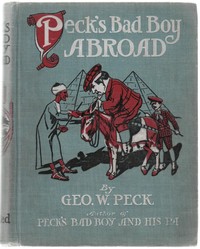
The source record for Peck's bad boy abroad — Story, Setting & Ideas measures this digital text at 71,326 words, 5 hr 11 min estimated reading time, and 9 detected text sections.
The text analysis averages about 42.4 words per sentence, while the detected sections provide another way to judge how the source is divided.
Project Gutenberg metadata also associates the work with “American wit and humor,” connecting these edition facts with the source record’s subject description.
Explore this collection
These alternatives are selected using recorded categories and estimated reading time.
About 298 minutes
Exploration Survival Adventure Tales
68,478 recorded words. 13 minutes difference from this book's estimate.
View Gutenberg source #20230About 328 minutes
Exploration Survival Adventure Tales
75,251 recorded words. 17 minutes difference from this book's estimate.
View Gutenberg source #28989About 293 minutes
Exploration Survival Adventure Tales
67,176 recorded words. 18 minutes difference from this book's estimate.
View Gutenberg source #30980Search stored excerpts and compare books → Choose by your preferences →
Choices use stored catalog measurements. Estimates vary with reading speed. A shared category is a catalog label, not a claim that two books have the same argument or literary quality.
Search reads excerpt text stored with this catalog and links to its associated Gutenberg record. The connection is stored in the site database; this tool does not recheck that every excerpt is word-for-word identical to that external record. Excerpt search does not cover every chapter and does not verify historical publication dates.
Catalog snapshot checked: 2026-09-25. Coverage: 95 public books, 95 available source excerpts.
Read the complete public-domain text at its original source.
Read on Project GutenbergThe Bad Boy’s narrative voice in Peck’s Bad Boy Abroad is a deliberate, sustained performance: a first-person account that sounds like a boy talking fast, mixing slang, hyperbole, and sudden shifts from practical jokes to geological explanations. The excerpt on Vesuvius and Pompeii shows this voice at work—comparing the earth’s crust to a potato patch, lava to cold buckwheat cakes, and the eruption to a chimney needing sweeping. The humor depends on incongruity: the same speaker who describes “petrified barroom” whisky also recalls throwing ashes over a fence at his dad. This editorial note examines how the book’s language, narrative stance, and changes in pace create its comic effect.
The narrator’s voice is the book’s engine. He uses colloquialisms (“Gee,” “you see, don’t you?”) and addresses the reader directly, as if telling a story to a friend. His similes are deliberately lowbrow: Vesuvius is “the spigot” for molten rock, and the earth is “a barrel of beer.” The humor lies in the gap between the grand subject (a volcanic eruption) and the mundane comparison (a bartender tapping a keg). The Bad Boy also employs a deadpan tone when describing absurd situations—such as his dad carrying an umbrella against volcanic ash—as if such behavior were perfectly reasonable. This voice remains consistent across the excerpt, whether he is explaining geology or recounting a prank, creating a unified comic persona.
The narrative pace in the Pompeii passage is notable for its digressive structure. The Bad Boy starts with a scientific explanation of Vesuvius, then veers into a personal anecdote about throwing ashes over a fence, then returns to the historical destruction of Pompeii, and finally loops back to his dad’s eagerness to dig for treasure. This zigzag rhythm mimics a child’s associative thinking and keeps the reader off balance. The digression about the backyard ashes is a miniature comic set piece: it escalates from a petty prank to a mock-heroic burial, ending with the image of the dad “petrified with your hatchet.” Such shifts in scale—from global catastrophe to domestic mischief—are a hallmark of the book’s pacing, preventing any single tone from dominating.
Although the Bad Boy is the narrator, his father is a constant presence and foil. In the excerpt, the dad is characterized through his reactions: he wants to dig in the ashes because it sounds “more exciting than raking over the dumping grounds in Chicago”; he insists on carrying an umbrella for protection against Vesuvius. These details paint him as gullible, practical, and slightly ridiculous—a perfect straight man for the Bad Boy’s antics. The narrative voice often reports the dad’s words or actions with a hint of mockery, as when the Bad Boy notes that his father was “paralyzed” by the idea of a buried town. The dad’s earnestness contrasts with the boy’s irreverence, and this dynamic drives much of the comedy, even in passages that are ostensibly about history or travel.
Readers should pay attention to how the Bad Boy’s voice controls the flow of information: he can shift from a pseudo-scholarly lecture to a personal memory in a single sentence, and the humor often depends on the reader recognizing the absurdity of the comparison. The dad’s role as a foil is consistent, but his character is revealed only through the boy’s narration, so every detail about him is filtered through a comic lens. The book rewards attention to its verbal play and structural digressions rather than any sustained plot.
For years I’ve watched Peck’s rowdy lad stumble through Europe, his laugh a little armor against the strange. Something in that restlessness reminds me of another lonely soul, one who finds his truest voice not in cities but in vast, patient desert light. That quieter kinship lives in Bred of the Desert: A Horse and a Romance — Context and Discussion, a book I return to when I miss the feel of open ground under a long silence.
Capture what you thought, learned, and would like to remember.