About 381 minutes
Daisy Brooks; Or, A Perilous Love — Key Ideas to Explore
Exploration Survival Adventure Tales
87,595 recorded words. 16 minutes difference from this book's estimate.
View Gutenberg source #30137
For Across the Mesa — Key Ideas to Explore, the stored edition analysis reports 83,818 words, 6 hr 5 min estimated reading time, and 10 detected text sections.
The text analysis averages about 13.5 words per sentence, while the detected sections provide another way to judge how the source is divided.
Project Gutenberg metadata also associates the work with “Americans -- Mexico -- Fiction,” connecting these edition facts with the source record’s subject description.
Explore this collection
These alternatives are selected using recorded categories and estimated reading time.
About 381 minutes
Exploration Survival Adventure Tales
87,595 recorded words. 16 minutes difference from this book's estimate.
View Gutenberg source #30137About 340 minutes
Exploration Survival Adventure Tales
77,998 recorded words. 25 minutes difference from this book's estimate.
View Gutenberg source #31380About 328 minutes
Exploration Survival Adventure Tales
75,251 recorded words. 37 minutes difference from this book's estimate.
View Gutenberg source #28989Search stored excerpts and compare books → Choose by your preferences →
Choices use stored catalog measurements. Estimates vary with reading speed. A shared category is a catalog label, not a claim that two books have the same argument or literary quality.
Search reads excerpt text stored with this catalog and links to its associated Gutenberg record. The connection is stored in the site database; this tool does not recheck that every excerpt is word-for-word identical to that external record. Excerpt search does not cover every chapter and does not verify historical publication dates.
Catalog snapshot checked: 2026-09-25. Coverage: 95 public books, 95 available source excerpts.
Read the complete public-domain text at its original source.
Read on Project GutenbergThe novel opens with Polly Street driving her electric car down Michigan Boulevard, resentful of her family's restrictions and her broken engagement to Joyce Henderson. The early chapters establish a vivid sense of place—Chicago's cold spring, then the Arizona desert and the Mexican mining town of Athens—while introducing a cast of characters including her brother Bob, the enigmatic Hard, and the singer Mrs. Conrad. The excerpts reveal a narrative voice that balances social observation with romantic tension, often using dialogue to expose characters' assumptions about class and gender.
The opening chapter establishes Polly's frustration with her circumstances: she hates driving the electric car, her brother Bob is marrying in Arizona, and her engagement has ended. The narrative dwells on her sense of confinement—'bitterness in her heart'—and her desire for a gas car or a chauffeur. This urban discontent is immediately contrasted with the desert setting when Polly travels to Mexico. The excerpts show the author using landscape to signal emotional shifts: the 'hilly country' and 'mountains, irregular, dark, and mysterious' under moonlight prompt Polly to reflect on Mrs. Conrad's life. The desert is not just a backdrop but a catalyst for introspection and romantic possibility.
The excerpts rely heavily on conversation to reveal character and advance the plot. Polly and Scott's exchange on the porch is a key example: Scott teases Polly about her assumptions, calling her 'a good deal of a kid,' while Polly defends herself with self-deprecating humor. Their banter touches on luck, superstition, and life experience—'I've noticed that people who are always expecting bad luck usually get it.' The dialogue also conveys backstory, as when Scott recounts Mrs. Conrad's history: her failed romance with Hard, her marriage to an Englishman, and her husband's death. These conversations feel natural and unforced, giving the reader insight into social dynamics and past events without heavy exposition.
Polly's character is defined by her struggle against the roles assigned to her. She is a 'daring horsewoman, a crack swimmer and a golf champion,' yet she is denied a gas car and must drive an electric. Her broken engagement is a public embarrassment, and she resents being treated as naive. The excerpts suggest a tension between her desire for autonomy and the constraints of her social class. Scott's comment about her being 'brought up... having everything easy' stings because it implies she lacks resilience. Meanwhile, Mrs. Conrad's story—choosing a career over marriage, then marrying later—offers an alternative model. The novel seems to explore whether Polly can forge her own path in a world that expects her to marry and conform.
Readers should pay attention to how the author uses setting to mirror internal states, and how dialogue carries both plot and theme. The excerpts offer a strong sense of Polly's voice—wry, self-aware, and restless—but the full novel may develop her relationships and choices further. The catalog subjects (Americans in Mexico, young women, love, adventure) are all present in the excerpts, but the story's texture comes from its specific details: the electric car, the moonlit desert, the mining town of Athens.
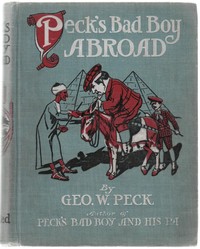
There’s something about Polly’s restless Chicago days that reminded me of another wandering soul—one who never quite fits where he’s planted. The desert stretches between them somehow, that quiet ache of wanting somewhere else. I kept thinking of Peck's bad boy abroad — Story, Setting & Ideas while reading, that same tug between home and horizon, never fully settled.
Create a short personal record of your experience with this book.