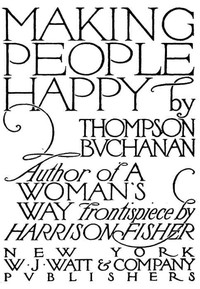
Making People Happy — Background and Themes

(5 User reviews)   1463
Buchanan, Thompson, 1877-1937, Fisher, Harrison, 1875-1934 [Illustrator] Project Gutenberg 2009 Not confirmed
New York (N.Y.) -- Fiction; Married women -- Fiction; Rich people -- Fiction; Women -- Societies and clubs -- Fiction Readers of public-domain and historical texts
Project Gutenberg digital edition en

Edition facts

Words 55,889
Reading time 243 min
Text sections 6

The catalog record for Making People Happy — Background and Themes provides practical reading context through 55,889 words, 4 hr 3 min estimated reading time, and 6 detected text sections.

The text analysis averages about 14.6 words per sentence, while the detected sections provide another way to judge how the source is divided.

Project Gutenberg metadata also associates the work with “New York (N.Y.) -- Fiction,” connecting these edition facts with the source record’s subject description.

An editorial note on Thompson Buchanan's 1911 novel, focusing on its structure of club meetings and domestic scenes, recurring imagery of gavels and controlled chaos, and movement between public debate and private tension.
Share
Editorial Edition Score 4.7/5

Calculated from edition completeness, EPUB availability, text structure and catalogue metadata. Not a user rating.

How this score is calculated
  • Description quality20 pts
  • Title & short description10 pts
  • Source metadata20 pts
  • Text length15 pts
  • Chapters / structure15 pts
  • EPUB file integrity20 pts

Total of 100 points, scaled to a 2.5-5.0 range. Editions with an empty description or a missing EPUB file are not scored.

Edition quality

Read the Text

There were many exclamations of assent to Mrs. Carrington's timely proposal, and much nodding of heads. Plainly, the ladies were minded to start the society forthwith. Unhappily, however, there remained an obstacle to the accomplishment of that desirable end--a somewhat general ignorance as to the proper method of procedure. Ruth Howard turned the gaze of her large brown eyes wistfully on Mrs. Carrington, and voiced the dilemma by a question:

"How do we start?" she asked, in a tone of gentle wonder.

Before Mrs. Carrington could formulate a reply to this pertinent interrogation, the militant suffragette from England began an oration.

"The start of a great movement such as is this," Mrs. Flynn declaimed, "is like unto the start of a great race, or the start of a noble sport; it is like--"

Cicily was so enthusiastic over this explanation that she interrupted the speaker in order to demonstrate the fact that she understood the matter perfectly.

"You mean," she exclaimed joyously, "that you blow a whistle, or shoot a pistol!"

This appalling ignorance of parliamentary tactics induced some of the more learned to ill-concealed titters; Miss Johnson permitted herself to laugh in a gurgling note that she affected. But it was Mrs. Carrington who took it on herself to utter a veiled rebuke.

"I fear Mrs. Hamilton has not been a member of many clubs," she remarked, icily.

At Miss Johnson's open flouting, Cicily had flushed painfully. Now, however, she was ready with a retort to Mrs. Carrington's implied criticism:

"Oh, on the contrary!" she exclaimed. "Why, I was chief rooter of the Pi Iota Gammas, when I went to boarding-school at Briarcliff."

Miss Johnson spoke with dangerous suavity of manner:

"Then, my dear, since you were one of the Pigs--pardon my using the English of it, but I never could pronounce those Greek letters--"

"Of course not," Cicily interrupted, with her sweetest smile. "I remember, Helen, dear: you had no chance to practise, not having belonged at Briarcliff."

Kindly Mrs. Delancy was on nettles during the passage of the gently spoken, but none the less acrimonious, remarks between her niece and Miss Johnson. She was well aware of Cicily's deep-seated aversion for the coquettish older woman, who had not scrupled to employ all her arts to win away another's lover. That she had failed utterly in her efforts to make an impression on the heart of Charles Hamilton did not mitigate the offense in the estimation of the bride. So strong was Cicily's feeling, indeed, and so impulsive her temperament, that the aunt was really alarmed for fear of an open rupture between the two young women, for Helen Johnson had a venomous tongue, and a liking for its employment. So, now, Mrs. Delancy hastened to break off a conversation that threatened disaster.

"Let us select the officers, the first thing," she suggested, rising for the sake of effectiveness in securing attention to herself. "It is, I believe, usual in clubs to have officers, and, for that reason, it seems to me that it would be well to select officers for this club, here and now." Mrs. Delancy reseated herself, well satisfied with her effort, for there was a general buzz of interest among her auditors.

Cicily, with the lively change of moods that was distinctive of her, was instantly smiling again, but now with sincerity. Without a moment of hesitation, she accepted the suggestion, and acted upon it. She turned toward Mrs. Carrington, and addressed her words to that dignified person:

"Yes, indeed," she declared gladly, "I accept the suggestion.... Won't you be president, Mrs. Carrington?"

The important lady was obviously delighted by this suggestion. She smiled radiantly, and she fairly preened herself so that the spangles on her black gown shone proudly.

"Thank you, my dear Mrs. Hamilton," she replied tenderly, with a pretense of humility that failed completely. "But I believe there are certain formalities that are ordinarily observed--I believe that it is a matter of selection by the club as a whole. Of course, if--" She paused expectantly, and regarded those about her with a smile that was weighted with suggestion.

Cicily was somewhat perturbed by the error into which she had fallen. It occurred to her that Helen Johnson might here find another opportunity for the gratification of malice. A glance showed that this detestable young woman was in fact exchanging pitying glances with Mrs. Flynn. Cicily was flushed with chagrin, as she spoke falteringly, with an apologetic inflection:

"Oh, the president has to be elected? I beg your pardon! I thought it was like the army, and--went by age."

At this unfortunate explanation, the simper of gratified vanity on Mrs. Carrington's features vanished as if by magic. She stiffened visibly, as she acridly ejaculated a single word:

"Really!" The inflection was scathing.

Mrs. Flynn, who was smiling complacently over the evident confusion of Cicily, now stood up to instruct that unhappy presiding officer:

"No, indeed, Mrs. Hamilton," she announced with great earnestness, "for the most part, it is the young women, even young wives no older than yourself oftentimes, who are at the front, fighting gloriously the battle of all women in this great movement.... At least, that is the way in England." She paused and bridled as she surveyed the attentive company, her manner full of self-content. "There, I may say, the youngest and the most beautiful women have been the leaders in the fray. Ahem!"

Cicily did not hesitate to remove all ambiguity from the utterance of the militant suffragette with the sallow, narrow face.

"And you were a great leader, were you not, Mrs. Flynn?" she demanded, bluntly.

There were covert smiles from the other women; but the Englishwoman was frankly gratified by the implication. She was smiling with pleasure as she answered:

"I may say truthfully that I know the inside of almost every police-station in London."

At this startling announcement, uttered with every appearance of pride, the suffragette's hearers displayed their amazement by exclamations and gestures. Mrs. Carrington especially made manifest the fact that she had scant patience with this manner of martyrdom in the cause of woman's emancipation.

"My dear Mrs. Flynn," she said, with a hint of contempt in her voice, "here in America, we do not think that getting into jail is necessarily a cause for pride." There were murmurs of assent from most of the others; but Mrs. Flynn herself was in no wise daunted.

"Well, then, it should be," she retorted, briskly. "Zeal is the watchword!"

"I think that Mrs. Flynn should be president," Miss Johnson cried with sudden enthusiasm. "She has suffered in the cause!"

"Oh, for that matter," interjected Mrs. Morton flippantly, "most of us are married." It was known to all those whom she addressed, save perhaps the Englishwoman, that at the age of forty Mrs. Morton had undergone two divorces, and that she was now living wretchedly with a third husband, so she spoke with the authority of one having had sufficient experience.

But Mrs. Flynn was too much interested in her own harrowing experiences to be diverted by cynical raillery.

"The last time I went to jail," she related, "I had chained myself to the gallery in the House of Commons, and, when they tried to release me, I bit a policeman--hard!"

"Oh, you man-eater!" It was Cicily who uttered the exclamation, half-reproachfully, half-banteringly.

"I fail to see why, if one should prefer even Chicago roast beef to an Irish policeman, that should be held against one." This was Mrs. Carrington's indignant comment on the narrative of the mordant martyr.

The remark affected Mrs. Flynn, however, in a fashion totally unexpected. She cried out in genuine horror and disgust over the suggested idea.

"Good heavens! Do you imagine I would ever bite an Irish policeman?"

"If not," Mrs. Carrington rejoined slyly, "you will have very small opportunity in New York for the exercise of your very peculiar talents."

Cicily interposed a remark concerning the appetizing charms of some of the mounted policemen. It seemed to her that the conversation between the two older women had reached a point where interruption were the course of prudence. "I think we had better do some more business, now," she added hastily, with an appealing glance toward her aunt.

Mrs. Delancy rose to the emergency on the instant.

"By all means," she urged. "Let us get on with the business. We haven't been going ahead very fast, it seems to me. Why not elect the officers right away?"

Once again, the entire company became agog with interest over the project of securing duly authorized officials. There were murmured conversations, confidential whisperings. As Ruth Howard earnestly declared, it was so exciting--a real election. A stealthy canvas of candidates was in full swing. The names of Mrs. Flynn and of Mrs. Carrington were heard oftenest. Incidentally, certain sentences threw light on individual methods of determining executive merit. A prim spinster shook her head violently over some suggestion from the woman beside her. "No, my dear," she replied aggressively, "I certainly shall not vote for her--vote for a woman who wears a transformation? No, indeed!"... Cicily improved the interval of general bustle to inquire secretly of her aunt as to the possible shininess of her nose. "It always gets shiny when I get excited," she explained, ruefully. As a matter of fact, there was nothing whatever the matter with that dainty feature, which had a fascination all its own by reason of the fact that one was forever wondering whether it was classically straight or up-tilted just the least infinitesimal fraction.

It was Mrs. Morton who first took energetic action toward an election. She stood up, and spoke with a tone of finality:

"I think that dear Mrs. Carrington would make a splendid officer. I nominate dear Mrs. Carrington for our president."

"Did you hear that, Mrs. Carrington?" Cicily inquired, with a pleased smile for the one thus honored. "You're nominated."

"Oh, it's so thrilling!" Ruth Howard exclaimed, with irrepressible enthusiasm.

But Miss Johnson, to whom Ruth particularly addressed herself, had on occasion been unmercifully snubbed by Mrs. Carrington. In consequence, now, she showed no sign of sympathy with her companion's emotion. On the contrary, she sniffed indignantly, and muttered something about "that woman!"

Meantime, Mrs. Morton was waxing restless over the fact that things remained at a standstill, despite the nomination she had made. She rose to her feet, and surveyed the company with a glance eloquent of haughty surprise.

"I am waiting for a second to my motion," she remarked, icily. Then, as there was no audible response to this information, she added with rising indignation: "Well, really!" There was a wealth of contemptuous reproach in the tone.

The effect on the susceptible Cicily was instantaneous. With her customary impulsiveness, and her eagerness to do the right thing for any and all persons, she felt that she herself had been woefully remiss in not having hurried to Mrs. Morton's support at once. So, to make amends, she spoke with vivacity:

"Oh, I second it!... Mrs. Carrington," she continued, turning to the gratified candidate, "you're seconded." She was rewarded for her conduct by a stately bow of thanks from Mrs. Morton. Half a dozen others, taking their cue from the presiding officer, noisily cried out in seconding the candidacy of Mrs. Carrington, whereat Mrs. Morton grew flushed with pleasure, and was moved to consummate the affair without a moment's delay.

"I move that the election of Mrs. Carrington as president be now made, and also that the election be made unanimous," she demanded, with much unction in her voice. She smiled persuasively at the presiding officer as she concluded: "Won't you put that motion, my dear?"

Cicily rose to the occasion with an access of becoming dignity.

"It is moved and seconded," she announced loudly, "that Mrs. Carrington be elected president of this club. All in favor of this motion--"

"One moment, please," Miss Johnson interrupted, excitedly. "Madam Chairman, I move that Mrs. Flynn, the great, the tried, the proven, the trusted crusader in the cause of women, from England, be elected president, and that her election be made unanimous." She paused to turn to Ruth, whom she addressed in a fierce whisper: "If you don't second me, I'll never speak to you again."

"Oh, I second you," Ruth cried, anxiously. "Of course, I second you."

But, by this time, Cicily had come to a realization of the fact that the other women present were every whit as ignorant of parliamentary law as was she herself. So, in this emergency, she did not scruple to make audacious retort. She answered with exceeding blandness:

"But, you see, Miss Johnson, there's already a motion before the house."

Thereupon, Mrs. Morton hastened valiantly to her own support.

"Yes, indeed," she declared, haughtily; "my motion was first. I must insist that it be voted upon. If Miss Johnson wished to have an imported English president for our American society, she should have nominated Mrs. Flynn first." She made direct appeal to the presiding officer. "Am I not right, dear?"

Cicily beamed on Mrs. Morton, and was about to reply, when a sudden thought came to her that did greater credit to her ingenuity than to her executive knowledge. Forthwith, she beamed, somewhat hypocritically, on Miss Johnson in turn.

"Yes, certainly," she affirmed; "I'm sure you're both quite right."

"Thank you, Madam Chairman, for agreeing with me," Miss Johnson replied, placated by Cicily's unexpected amiability toward her. "My motion also is before the house, and I insist that it be voted on. Mrs. Flynn has been seconded."

There was a spirit of hostility in the manner with which Miss Johnson and Mrs. Morton faced each other that boded ill for peace. The rival candidates sat in rigid erectness, disdainfully aloof while their supporters wrangled. The whisperings of the others suggested a growing acrimoniousness of debate. That earnest maiden, Ruth, was alarmed by the tension of strife.

"I think I'd rather go," she faltered. "I'm afraid you're going to quarrel, Helen."

But the resources of Cicily's inspiration were by no means ended. She waved a conciliatory hand toward the adversaries, and spoke with an air of finality that produced an instantaneous effect as of oil on troubled waters.

"I'll tell you: I'll put one motion, and the other can be an amendment." At this profound suggestion, the whole company breathed a sigh of relief. Only Ruth appeared somewhat puzzled.

"What's an amendment?" she questioned frankly, while the others regarded her with evident scorn for such ignorance.

"An amendment, Ruth," the presiding officer explained patiently, "is--is--oh, just listen, and don't interrupt the proceedings, and you'll know all about it in a few minutes." She beamed once again, first on Mrs. Morton and then on Miss Johnson. "Which of you would rather be the amendment?" she inquired.

Mrs. Morton, as became her years, was first to make reply.

"It's entirely immaterial to me, just so my motion is put."

Miss Johnson adopted a manner that was not without signs of heroic self-sacrifice.

"I'll be the amendment," were her words. With that, she bowed very formally to Mrs. Morton, who returned the salute with a fine dignity, after which the two at last subsided into their chairs.

Cicily was elated with the subtle manner in which she had evolved order out of chaos. Her eyes glowed with pride, and the flush in her cheeks deepened. There was an added music in her voice, as she once more addressed the company.

"Splendid!" she ejaculated. "Now, all in favor of Mrs. Motion's morton--I mean Mrs. Morton's motion, please say ay!"

In a clear, ringing voice she led the chorus in the affirmative. Yes, every woman present, including the presiding officer, voted an enthusiastic ay, whereupon Cicily declared the motion carried; and Mrs. Morton rose and said: "Thank you, ladies." Next, Mrs. Carrington stood up, placed a hand on her heart, and expressed her appreciation of the honor done her: "I deeply thank you, ladies." The incident was fittingly concluded by an outburst of applause in which all the club joined, although Ruth beat her palms in rather a bewildered manner.... Cicily immediately entered on the new phase of the situation.

"Now, all in favor of Miss Johnson's amendment, please say ay," she directed. Again, she led the chorus in the affirmative, and the entire company joined in the vote without a dissenting voice. "Amendment carried," the presiding officer announced, gleefully. It was now the turn of Miss Johnson to rise and offer her thanks, and Mrs. Flynn followed, saying, very neatly: "From over the sea, I thank you." The usual applause was of the heartiest.... But Cicily was still energetic.

"Now, all in favor of the motion and of the amendment, please say ay," she requested. For the third time, she led the chorus, and the vote was unopposedly affirmative. "The motion and the amendment are carried unanimously," Cicily announced, and the hand clapping sounded a happy content on the part of the Civitas Club.

Afterward, came a little intermission of conversation in which was expressed much appreciation of the efficiency of the club in carrying on its session. "It all goes to show how businesslike women can be," Mrs. Carrington remarked, triumphantly. Mrs. Flynn was even more emphatic. "I've never seen a meeting more gloriously typical of our great cause." The tribute was welcomed with a buzz of assent.... But, finally, there came a lull in the talking. It was broken by Mrs. Delancy, who spoke thoughtlessly out of a confused mind, with no suspicion as to the sinister effect to be wrought by her words:

"Who's elected?" was her simple question.

There was a moment of amazed silence, in which the members of the club stared at one another with widened eyes. It was broken very speedily, however, by Mrs. Carrington, who rose to her feet with more activity of movement than was customary to her dignified bearing.

"I have the honor," she stated, sharply.

Instantly, Mrs. Flynn, the militant suffragette, was up, her face belligerent.

"Pardon me, but the honor belongs to me," she snapped, regarding the first claimant with a fierce indignation that was returned in kind. Most of the others were too confounded for speech, but Mrs. Morton rose to support her candidate's claims.

"Pray pardon me," she began placatingly, "but probably Mrs. Flynn does not understand. The interpretation of parliamentary law in England may be quite different. Probably, it is. The customs of that country vary widely from ours in many respects. So, they probably do in the matter of elections in clubs. Now, I belong to ten clubs--American clubs--and I assure you that, according to the parliamentary law in every one of those ten clubs, Mrs. Carrington is certainly elected."

This advocacy was, naturally, a challenge to Miss Johnson, who promptly rose up to champion her own candidate.

"Mrs. Carrington, I am sure, has no desire to take advantage of a distinguished stranger within our gates--and one who has served as gloriously in the cause as Mrs. Flynn--but, even if someone--" she regarded Mrs. Morton with great significance--"I say, even if someone should wish to take unfair advantage of a technicality, it would be altogether impossible, for my amendment to the original motion was carried--unanimously! Mrs. Flynn is the president of the club, duly elected."

Some hazy notion of parliamentary procedure moved Mrs. Flynn to a suggestion.

"I think the matter might best be settled by the chair," she said, doubtfully. "The chair put the motion. Let us then leave the decision to Madam Chairman." Mrs. Carrington nodded a stately agreement to the proposal, and the company as a whole appeared vastly relieved, with the exceptions of Miss Johnson, who sniffed defiantly, and of Ruth, who appeared more than ever bewildered by the succession of events.

Now, at last, Cicily felt herself baffled by the crisis of her own making. She looked from one to another with reproach in her amber eyes.

"But--but you cannot expect me to decide between my guests," she espostulated. There was appeal for relief in the pathetic droop of the scarlet lips of the bride, but it was of no avail. The company asserted with vehemence that she must render the decision in this unfortunate dilemma.... And, again, the angel of inspiration whispered a solution of the difficulty. Impulsive as ever, a radiant smile curved her mouth, and her eyes shone happily.

"Very well," she yielded. "Since you insist on putting your hostess in such an unfortunate position, I decide that it is up to the ladies themselves. Which one wishes to take the office, to force herself forward against the wishes of the other?" She cast a seemingly guileless glance of inquiry first on Mrs. Carrington, then on Mrs. Flynn, who simultaneously uttered exclamations of indignation at the imputation thus laid upon them.

Mrs. Carrington was quick to make explicit answer.

The novel opens not with a solitary heroine but with a bride hammering a gavel at a chaotic club meeting. This image—a young wife struggling to command a room of twelve loud women—establishes the book’s central tension between domestic roles and public ambition. The setting is Cicily Hamilton’s own drawing-room, yet the space is immediately transformed into a battleground for the Civitas Club, a women’s society devoted to “the emancipation of woman.” The bride’s gavel, a symbol of order, is thrown aside in frustration, only to be picked up again in later chapters. This recurring prop anchors the novel’s structure, which alternates between club sessions and private conversations, each scene testing the boundaries of authority and decorum.

The Gavel as a Structural Device

The gavel appears at key moments, marking transitions between chaos and control. In Chapter I, Cicily “beat a tattoo of outraged authority” to no avail; by Chapter X, she “beat a tattoo with the gavel” to call the club to order after a scandalous revelation about Mrs. McMahon’s children. The repeated action—hammering, throwing, retrieving—creates a rhythm that mirrors the club’s own fits and starts. The gavel is not merely a prop but a measure of Cicily’s evolving authority. When she throws it away, she resorts to a personal threat (“I’ll never speak to you again”); when she reclaims it, she relies on parliamentary procedure. This oscillation suggests that power in this world is both fragile and performative, dependent on the willingness of others to obey.

Controlled Chaos in the Drawing-Room

The club meetings are scenes of deliberate disorder. Women talk “loudly and swiftly and incessantly,” ignoring the chair. The narrator describes the room as being “in pandemonium,” yet the chaos is carefully orchestrated: each outburst is followed by a pause, a retort, or a strategic move. Mrs. Flynn, the militant suffragette, speaks with “aggressive energy”; Mrs. Carrington nurses “rancor” and opposes motions out of spite. The meetings are not just debates but performances of personality. Buchanan uses the club setting to compress multiple voices into a single space, creating a microcosm of conflicting agendas. The drawing-room itself becomes a stage where private grievances (Mrs. Morton’s grudge against Mrs. McMahon) are aired under the guise of public business.

Movement Between Public and Private Spaces

The narrative shifts between the club’s formal sessions and intimate exchanges in adjoining rooms. When three candidates are asked to wait in “the withdrawing-room at the back,” the curtained archway becomes a threshold between scrutiny and privacy. Similarly, Mrs. Delancy’s conversation with Mrs. McMahon about “little Jimmy” moves from public embarrassment to a whispered confession. These transitions highlight the porous boundary between the club’s ideals and the messy realities of its members’ lives. The novel’s structure—alternating between the gavel’s authority and the withdrawing-room’s confidences—suggests that the real work of “making people happy” happens not in formal motions but in these liminal spaces.

Recurring Imagery of Restraint and Release

Buchanan repeatedly describes bodies in states of tension: Cicily’s “tense” form, Mrs. McMahon’s “heaving” from a gilt chair that “seemed to creak a sigh of relief.” The women’s physicality—their flushed cheeks, gleaming eyes, and fuming silence—underscores the emotional stakes of each meeting. The gavel’s tattoo is a sound of restraint; the “babel of chatter” that follows is a release. This pattern extends to the club’s purpose: the “emancipation of woman” is discussed in a room that is itself a cage of social expectations. The novel’s imagery suggests that liberation is always partial, always interrupted by the next gavel strike.

Readers attentive to the novel’s structure will notice how Buchanan uses the club meeting as a framing device, compressing time and voices into a single charged space. The gavel, the curtained archway, and the repeated interruptions are not mere stage business but clues to the book’s central concern: the difficulty of collective action when personal rivalries and domestic duties intrude. The excerpts offer only a partial view, but they suggest a work that is less about grand reforms than about the small, frustrating negotiations that precede any change.

That rainy afternoon, Buchanan’s gavels and the fraying of public debate lingered with me, the way controlled chaos mirrors our own quiet rooms. It wasn’t a conscious search, but my hand drifted to The Comings of Cousin Ann — Context and Discussion, and I found the same domestic undertow, the same hush before a door closes.

Charlotte Hall
1 month ago

Emma Carter
4 weeks ago

Theodore Martinez
2 weeks ago

Amelia Campbell
4 weeks ago

Luke King
1 week ago

4
4 out of 5 (5 User reviews )

Add a Review

Your Rating *
  • ...
    Tony Roach - 1 month ago
    Making People Happy is shallow and clichéd. The suggestions are overly simplistic and lack depth. The author spends too much time on obvious points without offering anything new. It reads more like a pamphlet than a book. If you're looking for meaningful insights, this won't satisfy you.

  • ...
    Todd Huffman - 1 month ago
    Making People Happy is a feel-good book that lives up to its title. The author provides practical, simple advice that genuinely uplifts. The anecdotes are relatable and the tone is warm and encouraging. I finished it with a smile and a renewed perspective. A wonderful read for anyone who wants a bit of joy.

  • ...
    Michelle Jennifer Thornton - 1 week ago
    The book is an easy read with a positive message. It offers some good tips on finding happiness in everyday life. That said, some sections feel repetitive, and the advice is not particularly groundbreaking. Still, it serves as a nice reminder to appreciate the little things.


Reader reflection

How did this book work for you?

Your answers remain private and are stored only in this browser.

Your progress 0 / 10
1

Which reading stage best describes you?

2

How much did you enjoy the reading experience?

3

Would you encourage someone else to read it?

4

What was the reading difficulty like?

Related eBooks