The Life of the Party — Key Ideas to Explore

(3 User reviews)   687
Cobb, Irvin S. (Irvin Shrewsbury), 1876-1944, Preston, James M., 1873-1962 [Illustrator] Project Gutenberg 2008 Not confirmed
New York (N.Y.) -- Fiction; Humorous stories; Lawyers -- Fiction; Costume -- Fiction Readers of public-domain and historical texts
Project Gutenberg digital edition en

Edition facts

Words 18,542
Reading time 81 min
Text sections 2

Before opening The Life of the Party — Key Ideas to Explore, the edition data offers a quick orientation: 18,542 words, 1 hr 21 min estimated reading time, and 2 detected text sections.

The text analysis averages about 18.2 words per sentence, while the detected sections provide another way to judge how the source is divided.

Project Gutenberg metadata also associates the work with “New York (N.Y.) -- Fiction,” connecting these edition facts with the source record’s subject description.

Irvin S. Cobb's 1919 comic novel follows a lawyer's disastrous night in costume after a war-themed children's party, using period slang and farcical misunderstandings to skewer social pretensions and legal authority in New York City.
Share
Editorial Edition Score 4.5/5

Calculated from edition completeness, EPUB availability, text structure and catalogue metadata. Not a user rating.

How this score is calculated
  • Description quality20 pts
  • Title & short description10 pts
  • Source metadata20 pts
  • Text length15 pts
  • Chapters / structure15 pts
  • EPUB file integrity20 pts

Total of 100 points, scaled to a 2.5-5.0 range. Editions with an empty description or a missing EPUB file are not scored.

Edition quality

Read the Text

Blanche had brought his overcoat along and held it up for him, imparting to the service that small suggestion of a ceremonial rite which the members of her race invariably do display when handling a garment of richness of texture and indubitable cost. Mr. Leary let her help him into the coat and slipped largess into her hand, and as he stepped aboard the waiting elevator for the downward flight Mrs. Carroway's voice came fluting to him, once again repeating the flattering phrase: "You surely were the life of the party!"

It was fine to have been the life of the party. It was not quite so fine to discover that the taxicab to which he must entrust himself for the long ride up to West Eighty-fifth Street was a most shabby-appearing vehicle, the driver of which, moreover, as Mr. Leary could divine even as he crossed the sidewalk, had wiled away the tedium of waiting by indulgence in draughts of something more potent than the chill air of latish November. Mr. Leary peered doubtfully into the illuminated countenance but dulled eyes of the driver and caught a whiff of a breath alcoholically fragrant, and he understood that the warning relayed to him by Blanche had carried a subtle double meaning. Still, there was no other taxicab to be had. The street might have been a byway in old Pompeii for all the life that moved within it. Washington Square, facing him, was as empty as a graveyard generally is at this hour, and the semblance of a conventional graveyard in wintertime was helped out by a light snow--the first of the season--sifting down in large damp flakes.

Twice and thrice he repeated the address, speaking each time sharply and distinctly, before the meaning seemed to filter into the befogged intellect of the inebriate. On the third rendition the latter roused from where he was slumped down.

"I garcia, Steve," he said thickly. "I garcia firs' time only y' hollowed s'loud I couldn und'stancher."

So saying he lurched into a semiupright posture and fumbled for the wheel. Silently condemning the curse of intemperance among the working classes of a great city Mr. Leary boarded the cab and drew the skirts of his overcoat down in an effort to cover his knees. With a harsh grating of clutches and an abrupt jerk the taxi started north.

Wobbling though he was upon his perch the driver mechanically steered a reasonably straight course. The passenger leaning back in the depths of the cab confessed to himself he was a trifle weary and more than a trifle sleepy. At thirty-seven one does not dance and play children's games alternately for six hours on a stretch without paying for the exertion in a sensation of let-downness. His head slipped forward on his chest.

With a drowsy uncertainty as to whether he had been dozing for hours or only for a very few minutes Mr. Leary opened his eyes and sat up. The car was halted slantwise against a curbing; the chauffeur was jammed down again into a heap. Mr. Leary stepped nimbly forth upon the pavement, feeling in his overcoat pocket for the fare; and then he realised he was not in West Eighty-fifth Street at all; he was not in any street that he remembered ever having seen before in the course of his life. Offhand, though, he guessed he was somewhere in that mystic maze of brick and mortar known as Old Greenwich Village; and, for a further guess, in that particular part of it where business during these last few years had been steadily encroaching upon the ancient residences of long departed Knickerbocker families.

The street in which he stood, for a wonder in this part of town, ran a fairly straight course. At its western foot he could make out through the drifting flakes where a squat structure suggestive of a North River freight dock interrupted the sky line. In his immediate vicinity the street was lined with tall bleak fronts of jobbing houses, all dark and all shuttered. Looking the other way, which would be eastward, he could make out where these wholesale establishments tailed off, to be succeeded by the lower shapes of venerable dwellings adorned with the dormered windows and the hip roofs which distinguished a bygone architectural period. Some distance off in this latter direction the vista between the buildings was cut across by the straddle-bug structure of one of the Elevated roads. All this Mr. Leary comprehended in a quick glance about him, and then he turned on the culprit cabman with rage in his heart.

"See here, you!" he snapped crossly, jerking the other by the shoulder. "What do you mean by bringing me away off here! This isn't where I wanted to go. Oh, wake up, you!"

Under his vigorous shaking the driver slid over sideways until he threatened to decant himself out upon Mr. Leary. His cap falling off exposed the blank face of one who for the time being has gone dead to the world and to all its carking cares, and the only response he offered for his mishandling was a deep and sincere snore. The man was hopelessly intoxicated; there was no question about it. More to relieve his own deep chagrin than for any logical reason Mr. Leary shook him again; the net results were a protesting semiconscious gargle and a further careening slant of the sleeper's form.

Well, there was nothing else to do but walk. He must make his way afoot until he came to Sixth Avenue or on to Fifth, upon the chance of finding in one of these two thoroughfares a ranging nighthawk cab. As a last resort he could take the Subway or the L north. This contingency, though, Mr. Leary considered with feelings akin to actual repugnance. He dreaded the prospect of ribald and derisive comments from chance fellow travellers upon a public transportation line. For you should know that though Mr. Leary's outer garbing was in the main conventional there were strikingly incongruous features of it too.

From his neck to his knees he correctly presented the aspect of a gentleman returning late from social diversions, caparisoned in a handsome fur-faced, fur-lined top coat. But his knees were entirely bare; so, too, were his legs down to about midway of the calves, where there ensued, as it were, a pair of white silk socks, encircled by pink garters with large and ornate pink ribbon bows upon them. His feet were bestowed in low slippers with narrow buttoned straps crossing the insteps. It was Miss Skiff, with her instinct for the verities, who had insisted upon bows for the garters and straps for the slippers, these being what she had called finishing touches. Likewise it was due to that young lady's painstaking desire for appropriateness and completeness of detail that Mr. Leary at this moment wore upon his head a very wide-brimmed, very floppy straw hat with two quaint pink-ribbon streamers floating jauntily down between his shoulders at the back.

For reasons which in view of this sartorial description should be obvious, Mr. Leary hugged closely up to the abutting house fronts when he left behind him the marooned taxi with its comatose driver asleep upon it, like one lone castaway upon a small island in a sea of emptiness, and set his face eastward. Such was the warmth of his annoyance he barely felt the chill striking upon his exposed nether limbs or took note of the big snowflakes melting damply upon his thinly protected ankles. Then, too, almost immediately something befell which upset him still more.

He came to where a wooden marquee, projecting over the entrance to a shipping room, made a black strip along the feebly lighted pavement. As he entered the patch of darkness the shape of a man materialised out of the void and barred his way, and in that same fraction of a second something shiny and hard was thrust against Mr. Leary's daunted bosom, and in a low forceful rumble a voice commanded him as follows: "Put up your mitts--and keep 'em up!"

Matching the action of his hands everything in Mr. Leary seemed to start skyward simultaneously. His hair on his scalp straightened, his breath came up from his lungs in a gasp, his heart lodged in his throat, and his blood quit his feet, leaving them practically devoid of circulation and ascended and drummed in his temples. He had a horrid, emptied feeling in his diaphragm, too, as though the organs customarily resident there had caught the contagion of the example and gone north.

"That's nice," spake the fearsome stranger. "Now stay jest the way you are and don't make no peep or I'll have to plug you wit' this here gat."

His right hand maintained the sinister pressure of the weapon against the victim's deflated chest, while his left dexterously explored the side pockets of Mr. Leary's overcoat. Then the same left hand jerked the frogged fastenings of the garment asunder and went pawing swiftly over Mr. Leary's quivering person, seeking the pockets which would have been there had Mr. Leary been wearing garments bearing the regulation and ordained number of pockets. But the exploring fingers merely slid along a smooth and unbroken frontal surface.

"Wot t'ell? Wot t'ell?" muttered the footpad in bewilderment. "Say, where're you got yore leather and yore kittle hid? Speak up quick!"

"I'm--I'm--not carrying a watch or a purse to-night," quavered Mr. Leary. "These--these clothes I happen to be wearing are not made with places in them for a watch or anything. And you've already taken what money I had--it was all in my overcoat pocket."

"Yep; a pinch of chicken feed and wot felt like about four one-bone bills." The highwayman's accent was both ominous and contemptuous. "Say, wotcher mean drillin' round dis town in some kinder funny riggin' wit'out no plunder on you? I gotta right to belt you one acrost the bean."

"I'd rather you didn't do that," protested Mr. Leary in all seriousness. "If--if you'd only give me your address I could send you some money in the morning to pay you for your trouble----"

"Cut out de kiddin'," broke in the disgusted marauder. His tone changed slightly for the better. "Say, near as I kin tell by feelin' it, dat ain't such a bum benny you're sportin'. I'll jest take dat along wit' me. Letcher arms down easy and hold 'em straight out from yore sides while I gits it offen you. And no funny business!"

"Oh, please, please, don't take my overcoat," implored Mr. Leary, plunged by these words into a deeper panic. "Anything but that! I--you--you really mustn't leave me without my overcoat."

"Wot else is dere to take?"

Even as he uttered the scornful question the thief had wrested the garment from Mr. Leary's helpless form and was backing away into the darkness.

Out of impenetrable gloom came his farewell warning: "Stay right where you are for fi' minutes wit'out movin' or makin' a yelp. If you wiggle before de time is up I gotta pal right yere watchin' you, and he'll sure plug you. He ain't no easy-goin' guy like wot I am. You're gittin' off lucky it's me stuck you up, stidder him."

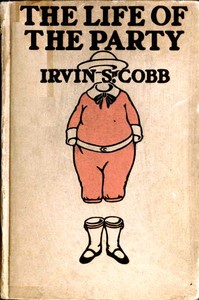
With these words he was gone--gone with Mr. Leary's overcoat, with Mr. Leary's last cent, with his latchkey, with his cardcase, with all by which Mr. Leary might hope to identify himself before a wary and incredulous world for what he was. He was gone, leaving there in the protecting ledge of shadow the straw-hatted, socked-and-slippered, leg-gartered figure of a plump being, clad otherwise in a single vestment which began at the line of a becomingly low neckband and terminated in blousy outbulging bifurcations just above the naked knees. Light stealing into this obscured and sheltered spot would have revealed that this garment was, as to texture, a heavy, silklike, sheeny, material; and as to colour a vivid and compelling pink--the exact colour of a slice of well-ripened watermelon; also that its sleeves ended elbow-high in an effect of broad turned-back cuffs; finally, that adown its owner's back it was snugly and adequately secured by means of a close-set succession of very large, very shiny white pearl buttons; the whole constituting an enlarged but exceedingly accurate copy of what, descriptively, is known to the manufactured-garment trade as a one-piece suit of child's rompers, self-trimmed, fastening behind; suitable for nursery, playground and seashore, especially recommended as summer wear for the little ones; to be had in all sizes; prices such-and-such.

Within a space of some six or seven minutes this precisely was what the nearest street lamp did reveal unto itself as its downward-slanting beams fell upon a furtive, fugitive shape, suggestive in that deficient subradiance of a vastly overgrown forked parsnip, miraculously endowed with powers of locomotion and bound for somewhere in a hurry; excepting of course no forked parsnip, however remarkable in other respects, would be wearing a floppy straw hat in a snowstorm; nor is it likely it would be adorned lengthwise in its rear with a highly decorative design of broad, smooth, polished disks which, even in that poor illumination, gleamed and twinkled and wiggled snakily in and out of alignment, in accord with the movements of their wearer's spinal column.

But the reader and I, better informed than any lamp post could be as to the prior sequence of events, would know at a glance it was no parsnip we beheld, but Mr. Algernon Leary, now suddenly enveloped, through no fault of his own, in one of the most overpowering predicaments conceivable to involve a rising lawyer and a member of at least two good clubs; and had we but been there to watch him, knowing, as we would know, the developments leading up to this present situation, we might have guessed what was the truth: That Mr. Leary was hot bent upon retreating to the only imaginable refuge left to him at this juncture--to wit, the interior of the stranded taxicab which he had abandoned but a short time previously.

Nearly all of us at some time or other in our lives have dreamed awful dreams of being discovered in a public place with nothing at all upon our bodies, and have awakened, burning hot with the shame of an enormous and terrific embarrassment. Being no student of the psychic phenomena of human slumber I do not know whether this is a subconscious harking-back to the days of our infancy or whether it is merely a manifestation to prove the inadvisability of partaking of Welsh rabbits and lobster salads immediately before retiring. More than once Mr. Leary had bedreamed thus, but at this moment he realised how much more dread and distressing may be a dire actuality than a vision conjured up out of the mysteries of sleep.

One surprised by strangers in a nude or partially nude state may have any one of a dozen acceptable excuses for being so circumstanced. An earthquake may have caught one unawares, say; or inopportunely a bathroom door may have blown open. Once the first shock occasioned by the untoward appearance of the victim has passed away he is sure of sympathy. For him pity is promptly engendered and volunteer aid is enlisted.

But Mr. Leary had a profound conviction that, revealed in this ghastly plight before the eyes of his fellows, his case would be regarded differently; that instead of commiseration there would be for him only the derision which is so humiliating to a sensitive nature. He felt so undignified, so glaringly conspicuous, so--well, so scandalously immature. If only it had been an orthodox costume party which Mrs. Carroway had given, why, then he might have gone as a Roman senator or as a private chief or an Indian brave or a cavalier. In doublet or jack boots or war bonnet, in a toga, even, he might have mastered the dilemma and carried off a dubious situation. But to be adrift in an alien quarter of a great and heartless city round four o'clock in the morning, so picturesquely and so unseasonably garbed, and in imminent peril of detection, was a prospect calculated to fill one with the frenzied delirium of a nightmare made real. Put yourself in his place, I ask you.

His slippered feet spurned the thin snow as he moved rapidly back toward the west. Ahead of him he could detect the clumped outlines of the taxicab, and at the sight of it he quickened to a trot. Once safely within it he could take stock of things; could map out a campaign of future action; could think up ways and means of extricating himself from his present lamentable case with the least possible risk of undesirable publicity. At any rate he would be shielded for the moment from the life which might at any moment awaken in the still sleeping and apparently vacant neighbourhood. Finally, of course, there was the hope that the drunken cabman might be roused, and once roused might be capable, under promise of rich financial reward, of conveying Mr. Leary to his bachelor apartments in West Eighty-fifth Street before dawn came, with its early-bird milkmen and its before-day newspaper distributors and its others too numerous to mention.

Without warning of any sort the cab started off, seemingly of its own volition. Mr. Leary's gait became a desperate gallop, and as he galloped he gave voice in entreaty.

"Hey there!" he shouted. "Wait, please. Here I am--here's your passenger!"

His straw hat blew off, but this was no time to stop for a straw hat. For a few rods he gained upon the vehicle, then as its motion increased he lost ground and ran a losing race. Its actions disclosed that a conscious if an uncertain hand guided its destinies. Wabbling this way and that it wheeled skiddingly round a corner. When Mr. Leary, rowelled on to yet greater speed by the spurs of a mounting misery, likewise turned the corner it was irrevocably remote, beyond all prospect of being overtaken by anything human pursuing it afoot. The swaying black bulk of it diminished and was swallowed up in the snow shower and the darkness. The rattle of mishandled gears died to a thin metallic clanking, then to a purring whisper, and then the whisper expired, dead silence ensuing.

In the void of this silence stood Mr. Leary, shivering now in the reaction that had succeeded the nerve jar of being robbed at a pistol's point, and lacking the fervour of the chase to sustain him. For him the inconceivable disaster was complete and utter; upon him despair descended as a patent swatter upon a lone housefly. Miles away from home, penniless and friendless--the two terms being practically synonymous in New York--what asylum was there for him now? Suppose daylight found him abroad thus? Suppose he succumbed to exposure and was discovered stiffly frozen in a doorway? Death by processes of congealment must carry an added sting if one had to die in a suit of pink rompers buttoning down the back. As though the thought of freezing had been a cue to Nature he noted a tickling in his nose and a chokiness in his throat, and somewhere in his system, a long way off, so to speak, he felt a sneeze forming and approaching the surface.

To add to his state of misery, if anything could add to its distressing total, he was taking cold. When Mr. Leary took cold he took it thoroughly and throughout his system. Very soon, as he knew by past experience, his voice would be hoarse and wheezy and his nose and his eyes would run. But the sneeze was delayed in transit, and Mr. Leary took advantage of the respite to cast a glance about him. Perhaps--the expedient had surged suddenly into his brain--perhaps there might be a hotel or a lodging house of sorts hereabouts? If so, such an establishment would have a night clerk on duty, and despite the baggageless and cashless state of the suppliant it was possible the night clerk might be won, by compassion or by argument or by both, to furnish Mr. Leary shelter until after breakfast time, when over the telephone he could reach friends and from these friends procure an outfit of funds and suitable clothing.

The novel opens with a meticulously described children's party for adults, where Mrs. Carroway has woven wartime thrift into the festivities: guests must donate the cost of their costume to a military charity. The narrator's tone is wryly admiring of her social engineering, noting that 'nine healthy adults out of ten dearly love to put on freakish garbings.' This elaborate setup—costumes, games, and patriotic fundraising—immediately establishes a world where appearances and performance are paramount.

The excerpts then shift to a street scene where Mr. Leary, still in costume, is arrested by Patrolman Switzer. The dialogue is thick with period slang ('bedaddled ijiet,' 'givin' a skate the bum's rush'), and the crowd's reaction is pure comic spectacle. The contrast between the controlled party and the chaotic arrest hints at the farce to come.

Costume as Social Currency

The party's premise—that adults must dress as children under twelve—is not merely whimsical but a vehicle for social competition. Mrs. Carroway's 'customary brilliancy' lies in linking costume expense to charitable donation, making thrift a public performance. The narrator notes that 'the donation of a person who wore an expensive costume would be relatively so much larger,' implying that wealth is on display even in disguise. This detail, drawn from the opening paragraphs, sets up a world where identity is fluid but status is always legible.

Later, Mr. Leary's costume—a 'bright pink' outfit—becomes a liability when he is mistaken for a drunk or a 'fancy nut.' His lawyerly authority evaporates under the patrolman's gaze. The excerpts do not reveal what his costume represents, but the contrast between his intended disguise and its public reception drives the comedy.

Voice and Vernacular

Cobb's dialogue is rich with Irish-inflected New York speech. Patrolman Switzer's lines—'Nothin' doin'!' and 'Who are you to be preferrin' anything at all?'—are laced with sarcasm and a streetwise cadence. The crowd's 'yells and gibes and quips' create a cacophony of mockery. Mr. Leary's own speech shifts from indignant to wheedling as he tries to explain his 'device' or 'trick' to avoid the mob.

The narrator's voice is equally distinctive: dry, amused, and fond of compound adjectives ('Carrowayian record,' 'whimsical McGillicuddys'). This verbal play extends to the physical comedy of 'givin' a skate the bum's rush,' where the jargon of the police force becomes a punchline. The excerpts suggest that the novel's humor depends heavily on the friction between formal legal language and colloquial insult.

The Night Court as Stage

When Mr. Leary learns he is headed to Jefferson Market night court, his dread is palpable: 'Mr. Leary could picture the rows...' The excerpt cuts off, but the setting is clearly a theatrical space where his costume and behavior will be judged. The magistrate is 'expectin' some raids,' implying that the court itself is a performance venue for the city's nightly dramas.

The patrolman's refusal to take Leary to the station house—insisting on the night court instead—strips the lawyer of his expected procedural rights. This inversion of authority (a lawyer outmaneuvered by a beat cop) is a recurring comic pattern. The excerpts do not reveal the outcome, but the stage is set for a public reckoning where Leary's professional identity may be as much a costume as his pink suit.

Structure and Pacing

The excerpts move from a leisurely, almost anthropological description of the party to a rapid-fire street scene. The first chapter's long paragraphs and parenthetical asides ('to be exactly truthful') give way to clipped dialogue and physical action. This shift mirrors Leary's own loss of control: from a guest at a carefully managed event to a prisoner propelled along the sidewalk.

The novel's word count (18,542) suggests a compact farce. The excerpts cover the opening and a later chapter (VII), indicating that the middle section likely develops Leary's predicament. The use of chapter breaks and the sudden jump from party to arrest imply a structure built on escalating misunderstandings. Readers should watch for how Cobb balances descriptive setup with comic payoff.

The excerpts offer a narrow but vivid window into Cobb's comic method: precise social observation, a ear for dialect, and a plot that hinges on mistaken identity. First-time readers should pay attention to how the costume—both literal and figurative—shapes every interaction. The novel's brevity means that every scene likely serves the farce; the night court promises to be a climax where all the performative threads converge. Approach the text as a period comedy of manners, not a legal thriller, and enjoy the linguistic play.

I keep thinking about how The Life of the Party laughs at those who think they’re in control, and yet it made me remember a quieter fear underneath—how easily our assumptions get turned on their heads. That same unease lingered when I found Spies of the Kaiser: Plotting the Downfall of England — Context and Discussion, with its own shadowy reversals. Different eras, same trembling ground beneath the surface.

Madison Garcia
3 weeks ago

Wyatt Anderson
4 weeks ago

Scarlett Walker
1 month ago

5
5 out of 5 (3 User reviews )

Add a Review

Your Rating *
  • ...
    Stacy Gibson - 3 weeks ago
    I had high hopes for this, but it fell flat for me. The so-called 'life of the party' is just a one-dimensional character who never really develops. The plot meanders and the humor feels forced. There are better books out there with similar themes. I honestly struggled to finish it and wouldn't recommend it unless you have nothing else to read.

  • ...
    Brandon Julie Fuller - 3 weeks ago
    It's a fun, light read with a charming protagonist and some genuinely funny moments. The plot is straightforward and enjoyable, though at times it feels a bit predictable. Still, it's the kind of book you can breeze through on a lazy afternoon. If you're looking for a feel-good story without too much complexity, this will do the trick.

  • ...
    Sara Mueller - 2 weeks ago
    Loved every minute of this book! The characters are so vivid and relatable, and the story perfectly captures the highs and lows of being the life of the party. It's funny, heartwarming, and surprisingly deep. I couldn't put it down and found myself thinking about it long after the last page. A must-read for anyone who enjoys character-driven stories with a lot of heart.


Reader reflection

What did you think of this book?

Answer a few questions and save a private reflection on this device.
Your progress 0 / 10
1

How far have you progressed with this book?

2

Did this book hold your interest?

3

Is this a title you would suggest to others?

4

How easy was the book to follow?

Related eBooks