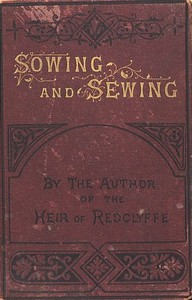
Sowing and Sewing: A Sexagesima Story — A Closer Reading

(2 User reviews)   392
Yonge, Charlotte M. (Charlotte Mary), 1823-1901 Project Gutenberg 2010 Not confirmed
Christian life -- Fiction; Villages -- Fiction; Young women -- Conduct of life -- Fiction; Church work -- Fiction Readers of public-domain and historical texts
Project Gutenberg digital edition en

Edition facts

Words 28,807
Reading time 126 min
Text sections 3

Before opening Sowing and Sewing: A Sexagesima Story — A Closer Reading, the edition data offers a quick orientation: 28,807 words, 2 hr 6 min estimated reading time, and 3 detected text sections.

The text analysis averages about 19.9 words per sentence, while the detected sections provide another way to judge how the source is divided.

Project Gutenberg metadata also associates the work with “Christian life -- Fiction,” connecting these edition facts with the source record’s subject description.

Charlotte M. Yonge's 1869 novel uses the metaphor of sewing to explore moral choices in a village setting, focusing on Jessie Hollis's struggle between profitable needlework and charitable work, with precise observations of domestic detail and inner conflict.
Share
Editorial Edition Score 4.5/5

Calculated from edition completeness, EPUB availability, text structure and catalogue metadata. Not a user rating.

How this score is calculated
  • Description quality20 pts
  • Title & short description10 pts
  • Source metadata20 pts
  • Text length15 pts
  • Chapters / structure15 pts
  • EPUB file integrity20 pts

Total of 100 points, scaled to a 2.5-5.0 range. Editions with an empty description or a missing EPUB file are not scored.

Edition quality

Read the Text

CHAPTER I. PAGE THE SERMON 1

CHAPTER II. THE SUNDAY SCHOOL 13

CHAPTER III. THE WORKING PARTY 28

CHAPTER IV. TEACHER AMY 49

CHAPTER V. THE TROUSSEAU 64

CHAPTER VI. STITCH, STITCH, STITCH 79

CHAPTER VII. WANDERING EYES 101

CHAPTER VIII. AMY'S VISITS 115

CHAPTER IX. AWKWARD MEETINGS 127

CHAPTER X. THE RECKONING 150

CHAPTER XI. WHICH SHALL PROSPER? 159

FOUR girls were together in a pleasant cottage room with a large window, over which fluttered some dry sticks, which would in due time bear clematis and Virginia creeper leaves.

Three of them were Miss Lee's apprentices, and this room had been built out at the back of the baker's shop for them. The place was the property of the Lee family themselves, and nobody in Langley was more respected than they were. Ambrose Lee, whose name was over the baker's shop, and who kept a horse and cart, was always called Mr. Lee.

He had married a pretty, delicate young girl, who had soon fallen into such hopeless ill-health, that his sister Charlotte was obliged to live at home to attend to her and to the shop. And when young Mrs. Lee died, leaving three small children, another sister, Rose, gave up her place to help in the care of her old father and the little ones.

Rose Lee had been a sewing maid, and, being clever, had become a very fair dressmaker; so she took in needlework from the first, and when good old master Lee died, and the children had grown old enough to be more off her hands, she became the dressmaker and sempstress of the place, since there was no doubt that all she took in hand would be thoroughly well turned out of hand, from a child's under garment up to Mrs. and Miss Manners's dresses. "For," as her sister Charlotte proudly said of her, "the ladies had everything made down here, except one or two dresses from London for the fashion." Her nephews were both from home, one as a pupil-teacher, the other at a baker's with a superior business, and her niece, Amy, the only girl of the family, had begun as a pupil-teacher, but she had such bad headaches at the end of her first year that her father was afraid to let her go on studying for examinations, and cancelled her engagement, and thus she became an assistant to her aunt. Then Jessie Hollis, from the shop, came home from her aunt's, unwilling to go to service, and begged Miss Lee to take her and teach her dressmaking; and, having thus begun, she consented, rather less willingly, to take likewise Florence Cray from the Manners Arms, chiefly because she had known her mother all her life, and believed her to be careful of the girl; besides which, it was a very respectable house.

As plain work, as well as dressmaking, was done, there was quite enough employment for all the hands, as well as for the sewing machine, at which Amy, a fair, delicate-looking girl, was whirring away, while Jessie was making the button-holes of a long _princesse_ dress, and Florence tacking in some lining; or rather each was pausing a little in her work to answer Grace Hollis, Jessie's sister, a businesslike-looking young person, dressed in her town-going hat and jacket, who had stepped in, on her way to meet the Minsterham omnibus, to ask whether Miss Lee wanted to have anything done for her, and likewise how many yards of narrow black velvet would be wanted for the trimming of her own and Jessie's spring dresses.

Miss Lee was gone up to the house for a grand measuring of all the children for their new frocks; but Amy began to calculate and ask questions about the width and number of rows, and Jessie presently said--

"After all, I think mine will look very well without any round the skirt."

"Why, Jessie, I thought you said the dress you saw looked so genteel with the three rows----"

"Yes," said Jessie; "but I have thought since--" and she hesitated and blushed.

Amy got up from the machine, came towards her, and, laying her hand on her, said, gently--

"And I know, though you wanted to keep it a secret!" cried Florence. "I was at church too last night!"

"Oh, yes, I saw you, Florence; and wasn't it beautiful?" said Amy, earnestly.

"Most lovely! It is worth something to have a stranger here sometimes to get a fresh hint from!" said Florence.

"I call that more than a hint," said Jessie, in a low voice. "I am so glad you felt it as I did, Flossy."

"Felt it! You don't mean that you got hold of it? Then you can tell whether it was cut on the bias, and how the little puffs were put on!"

"Why, what are you thinking of, Flossy?" exclaimed Amy. "Bias--puffs! One would think you were talking of a dress!"

"Well, of course I was. Of that lovely self-trimming on that cashmere dress of the lady that came with Miss Manners. What--what are you laughing at, Grace?"

"Oh! Florence," said Amy, in a disappointed tone; "we thought you meant the sermon."

"The sermon?" said Florence, half annoyed, half puzzled; "well, it was a very good one; but----"

"It did make one feel--oh, I don't know how!" said Jessie, much too eager to share her feelings with the other girls, even to perceive that Florence wanted to go off to the trimming.

"Wasn't it beautiful--most beautiful--when he said it was not enough only just not to be weeds, or to be only flowers, gay and lovely to the eye?" said Amy.

"Yes," went on Jessie; "he said that we might see there were some flowers just for beauty, all double, and with no fruit or good at all in them, but dying off into a foul mass of decay."

"Ay," said Grace; "I thought of your dahlias, that, what with the rain and the frost, were--pah!--the nastiest mess at last."

"Then he said," proceeded Jessie, "that there were some fair and comely, some not, but only bringing forth just their own seeds, not doing any real good, like people that keep themselves to themselves, and think it is enough to be out of mischief and do good to themselves and their families."

"And didn't you like it," broke in Amy, "when he said that was not what God asked of us? He wanted us to be like the wheat, or the vine, or the apple, or the strawberry, some plain in blossom, some fair and lovely to look at, but valued for the fruit they bring forth, not selfishly, just to keep up their own stock, but for the support and joy and blessing of all!"

"One's heart just burnt within one," continued Jessie, "when he bade us each one to go home and think what we could do to bring forth fruit for the Master, some thirty, some sixty, some an hundredfold. Not only just keeping oneself straight, but doing something for Christ through His members."

"Only think of its being for Christ Himself," said Amy softly.

"Well," said Grace, "I thought we might take turns to go to Miss Manners's missionary working parties. I never gave in to them before, but I shall not be comfortable now unless I do something. And was that what you meant about the velvet trimming, Jessie? It will save--"

"Fifteen pence," said Jessie.

"Very well--or you may say threepence more. So we can put that into the box, if you like. I must be going now, and look sharp if I'm to catch the bus. So good-bye, all of you."

"Oh! but won't you have the self-trimming," broke in Florence. "Perhaps she'll be there on Friday night, and then we might amongst us make out how it is done."

"Florence Cray, for shame!" said Grace. "I do believe you minded nothing but that dress all through that sermon."

"Well," said Florence, who was a good-humoured girl, "there was no helping it, when there it was just opposite in the aisle, and I'd never seen one like it; and as to the sermon, you've just given it to me over again, you've got it so pat; and I'll go to the missionary work meeting too, Grace, and very like the young lady will be there, and I can see her trimming."

"If you go for that, I would go to a fashion-book at once," said Grace; "but I must really be off now, I've not another minute to stop."

"Oh dear, I forgot," cried Florence, jumping up, "I was to ask you to call for our best tea-pot at Bilson's. And my mother wants a dozen--" and there her voice was lost as she followed Grace out of the room through the shop, and even along the road, discoursing on her commissions.

Amy and Jessie were left together, and Amy stood up and said:

"Dear, I am so glad you felt it as I did!"

"One could not help it, if one listened at all," said Jessie. "Amy, I must be doing something for His sake. I can't rest now without it. You teach at the Sunday school. Don't you think I might?"

Amy meditated a little.

"I think they would make up a class for you. When Miss Pemberton's niece goes away, the class she takes has to be joined to her aunt's, and that makes a large one."

"Then will you speak to Miss Manners for me?" asked Jessie. "Are they little girls or big ones?"

"Oh, that's the second class. They would be sure not to give you that," said Amy, as if she thought the aspiration very high, not to say presumptuous. "Perhaps Margaret Roller, the pupil-teacher, you know, may take that. Then I should have hers and you mine. They are dear little girls, some of them, only Susan Bray always wants a tight hand over her, Polly Smithers is so stupid, and Fanny Morris is so sly, one always has to be on the watch."

"Here she comes," said Florence, who was the nearest to the window, and the entrance of Aunt Rose, a brisk, fair little woman, young looking for her age, recalled all her "young ladies," as Florence and Jessie, and perhaps Amy likewise, preferred being called, to recollect that stitching was, at that moment at least, the first thing to be attended to.

PERHAPS Amy's business-like tone about the school classes fell a little flat upon Jessie's ear. She had not been to a Sunday school in her childhood. Her father had been a prosperous upholsterer's foreman in Minsterham, and Grace and Jessie had gone to an "academy" till, when they were sixteen and fourteen years old, their father died of a fever, and their mother, who had a cottage of her own at Langley, resolved on coming back and setting up a small shop there for all sorts of wares, with Clementina Hollis over the door.

Jessie was about eighteen, two years younger than her sister. She had always been a bright, quick, lively girl, but never very thoughtful, and much too inquisitive, till her curiosity had brought on her a terrible accident, which had kept her laid up in a hospital for many weeks. She had come home quite well at last, and much improved. A fellow patient, and likewise a lady who had visited her and lent her books, had both made much impression on her. She cared about right and wrong as she had never done before, was more useful at home, and tried to restrain her inclination to find out all about everything; she said her prayers more carefully, went to Church more often, and heeded more what she heard; and altogether she was what her mother called an altered girl. This was Lent, and a clergyman was staying with Mr. Somers to preach a course of sermons on the Friday evenings, and it was one of these that had so much struck these young girls, and had put into their minds for the first time, with any real force, the full sense that the true Christian must seek to work for the good of the household of Christ as well as his own household, and that "bringing forth good fruit" does not simply mean taking care of oneself, and trying to save one's own soul.

The language had been beautiful and stirring, and there was a burning desire in more than one heart to be doing something for Christ's sake. The first thing that Jessie thought of was the Sunday school. She had read books about it, and her fellow patient was full of ardour about "training little lambs," as she called it, so that it seemed the most beautiful and suitable task she could undertake.

Amy Lee, on the other hand, hardly knew how to spend a Sunday without the school. She had been a scholar there until she had quite outgrown the first class, and had been more than a year confirmed, and then she had become a teacher of the little ones. She liked the employment, and was fond of the children; she would have been sorry to drop the connection with Miss Manners or with Miss Joy, the mistress, and the rest of the school staff; she was pleased to work for and with Mr. Somers and Miss Manners, and she had been trained to be reverent and attentive; but it had never occurred to her to think of it as more than a nice and good thing to do, or to look on it as a work undertaken for Christ's sake.

"Teaching at school, I do that already," she said to herself, when Aunt Rose's entrance had made her work her machine more and her tongue less. "I must get something more to do. Oh! I know. There's poor old half-blind Mrs. Long. She is left to herself terribly, they do say, and I'll go and tidy her up, and see to her and read to her every day. I could do it before my work and after. Maybe I might get her to be a better old woman than she ever has been. Books say that nothing so softens an old woman as a nice, bright young girl coming in to make much of her, and I'm sure I'm nice and bright--not so much in myself, but compared with the whole lot of Longs."

So Amy told her plan to her aunts, as soon as Florence and Jessie had gone home to dinner.

The two aunts looked at one another, and Aunt Charlotte said, "Did the sermon make you think of that?" in rather a doubtful tone.

"Yes," said Amy. "One seemed to long to be doing some good, not be only an empty flower, as he said."

"Mrs. Long," said Aunt Rose; "she ain't a very nice person to fix upon."

"But no one wants it so much, aunt," said Amy.

"That's true," said Aunt Charlotte. "Well, Amy, we must think about it, and speak to your father. Run out now, and gather a bit of parsley for his cheese."

Amy knew it was to get her out of the way, and felt rather disappointed that the proposal was not seized upon at once, and applauded.

"She's a good girl," said Aunt Rose.

"Well, so she is, and I don't like to stand in her way," said Aunt Charlotte.

"But to pitch on old Sally Long of all folk in the world!" said Rose.

"There's no doubt but she does want something done for her; but I misdoubt me if she will choose our Amy to do it. Besides, I don't like her tongue. That's what daunts me most."

"Yes. If she took it kind of the girl, she would never be satisfied without talking to her of all the old backbiting tales that ever was! And we that have kept our girl up from hearing of all evil just like a lady--"

"What is it?" said Ambrose Lee, himself coming in, after putting up his cart.

"Why, that sermon last night has worked upon our Amy, so that she wants to do something extra," said Aunt Rose.

"A right down good sermon it was," said the father; "a bit flowery, to suit the maidens, I suppose."

"And she said it all off to me, quite beautiful," said Rose, who had stayed at home.

"And what does the child want to be doing? I won't have her go back to her books again, to worry her head into aching."

"No, that's not what she wants. Her notion is to run in and out and see to old Widow Long."

"Widow Long!" exclaimed the baker. "Why, she's got as slandering a tongue as any in the parish! Give the poor old soul a loaf or a sup of broth if you like, but I'll not have my girl running in and out to hear all the gossip of the place, and worse."

"I knew you would say so, Ambrose," returned Charlotte. "All the same, the child's thought shames me that I've never done anything for the poor old thing; and she won't harm me."

Ambrose chuckled a little. "I don't know but aunt likes a spice of gossip as much as her niece. 'Tis she tells us all the news."

"Well, I can get plenty of that in the shop, without going to Dame Long for it," said Charlotte, laughing. "I like the real article, genuine and unadulterated."

They were laughing at Aunt Charlotte's wit when Amy came in, and she looked from one to the other, afraid they were laughing at her project, and ready to be offended or hurt. She did not like it when her father said, "Look here, my girl, Aunt Charlotte says Dame Long's dish of tongue is too spicy for you, and she must have it for herself."

"I don't know what you mean, father," said Amy, nearly crying, "I didn't want it for that."

"No, you didn't, child," said Charlotte; "but come along here, I want you to help me dish up."

Amy came with the tears standing in her eyes into the back kitchen, vexed, angered, and ready to be cross. Her aunt set her to prepare the dish for the Irish stew, while she said, "Father was at his jokes with me, Amy. He don't like you to be running in and out to old Sally Long by yourself; no more does your Aunt Rosy nor I; but the poor old body didn't ought to be neglected, and the sermon was just as much for me as for you, so I've made up my mind to look after her a bit, and you may come in with me sometimes if you like."

"That was not what I meant," said Amy, rather fretfully.

"I dare say not. There, mind what you are about, or you'll have that dish down. Where's the flour? Come, now, Amy, don't be daunted, if you can't do good quite in your own way; why shouldn't you ask Miss Dora now?"

Amy muttered and pouted. "I'm not such a child now!"

"Ain't you then, to be making such a pout at not getting just your own way."

Down came the dish with a bounce on the table, and away ran Amy up the stairs, where she cried and choked, and thought how hard it was that she should be hindered, and laughed at, and scolded, when she wanted to do good, and bring forth the fruit of good works.

She heard Aunt Rose ask where she was, and her Aunt Charlotte answer, "Oh! she will be down in a minute."

She felt it kind that no one said that she was in the sulks. The relief did her good; she could not bear that any one should guess what was amiss. So she washed her face in haste, tidied her hair and collar, and hoped that she looked as if she had gone up for nothing else.

Perhaps her father had had a hint, and she was his great pet, so he took care that the apprentices should not suspect that Amy had been "upset." So he began to tell what had made him late at home. He had overtaken poor Widow Smithers in much trouble, for she had had a note from the hospital to say that her little boy, Edwin, must be discharged as incurable. It was a hip complaint, and he could not walk, and she had not been able to find any way of getting him home.

Charlotte M. Yonge's Sowing and Sewing: A Sexagesima Story opens not with a dramatic incident but with a detailed description of a cottage room and the four young women who work there. The narrator's eye lingers on the dry sticks that will later bear clematis and Virginia creeper, a small image that signals the story's attention to growth and patience. The exposition is woven through the introduction of the Lee family: Ambrose, his invalid wife, his sisters Charlotte and Rose, and his daughter Amy. Rose, a former sewing maid turned dressmaker, is described with a phrase that recurs in the story's logic: she ensures that everything she takes in hand will be 'thoroughly well turned out of hand.' This careful, almost proverbial language establishes the value system of the novel, where work and character are measured by the same standard of finish.

Diction and the Moral Weight of Sewing

Yonge's vocabulary consistently links needlework to moral and spiritual states. When Jessie Hollis considers giving up some of her sewing work to Bessie Needwood, a poor woman who 'never can keep a situation,' the narrator records Jessie's thought: 'I shall only finish this first dozen. I shall send the other five dozen to Bessie Needwood.' The precision of the numbers—'first dozen,' 'five dozen'—is typical of the story's method. The goods are countable, the labor is measurable, and the moral choice is expressed in the language of commerce and craft. Similarly, Grace's mind is described as running on 'seam and gusset and band,' a triplet that reduces the Sabbath to technical details. Yonge does not need to state that Grace's thoughts are worldly; the list of sewing terms does the work.

Dialogue as a Window to Inner State

The dialogue in the excerpts reveals character through tone and preoccupation. Mrs. Hollis's complaints are rendered in a breathless, cumulative style: 'she had been so put about to get off, with none of her things ready, and she was that tired and sleepy she had not heard a word of the sermon.' The run-on syntax mimics her agitation. In contrast, Jessie's speech is measured and deliberate. When she tells Grace about her decision to pass work to Bessie Needwood, she says simply, 'Miss Needwood will do them better than I.' Grace's reply—'Well I never! I never thought you'd turn lazy'—shows her quickness to judge and her reliance on a vocabulary of moral accusation. Yonge lets the characters condemn themselves through their own words.

Structure and the Rhythm of the Week

The story's structure is built around the church calendar and the weekly cycle. The first chapter is titled 'The Sermon,' and the action moves from Sunday to Sunday, with the working days in between. In the excerpt, Jessie's Sunday is described in a sequence of domestic and religious obligations: lighting the fire, setting out breakfast, going to school, attending church, returning to find her mother fretting, teaching in the afternoon, and coming home to a sleeping mother and a tired sister. The narrator notes that Jessie 'could forget all about it in the interest of teaching,' but the worry returns. This alternation between peace and anxiety is the story's basic rhythm. The physical details—the uncleaned house, the cheese going too fast, the threepence unaccounted for—anchor the moral drama in material life.

Recurring Details and the Texture of Village Life

Yonge builds her world through small, repeated observations. The Lee family's cottage has a window with dry sticks that will bear leaves 'in due time.' The phrase 'in due time' echoes the story's title and its liturgical reference to Sexagesima, the second Sunday before Lent. The baker's shop, the horse and cart, the 'superior business' where one nephew works—these details create a social geography. The narrator's habit of specifying the provenance of objects, such as 'Mrs. and Miss Manners's dresses' or 'a child's under garment,' gives the village a texture of rank and relationship. Even the cheese that Mrs. Hollis suspects is being eaten too fast is a character in its own right, a measure of household economy and trust.

Readers attentive to the story's verbal patterns will find that Yonge's method rewards close attention to small choices: a word like 'genteel' in Grace's mouth, the number of handkerchiefs Jessie agrees to sew, the exact moment when a character sits down or stands up. The novel does not announce its themes; it embeds them in the rhythm of work and worship. To read Sowing and Sewing is to watch a moral argument unfold through the details of a dressmaker's trade.

I kept thinking about that village sewing circle long after closing the book—how small stitches can hold such weighty choices. It reminded me of another quiet notebook that lingered, The Eye of Wilbur Mook — Reading Notes, where every margin feels like a whispered thought. There’s a tender patience in both, a noticing of tiny things that matter more than they seem.

Samuel Smith
1 week ago

Mia Ramirez
1 month ago

4
4 out of 5 (2 User reviews )

Add a Review

Your Rating *
  • ...
    Adam Campbell - 1 month ago
    Despite its promising premise, 'Sowing And Sewing' fails to truly engage. The plot is predictable, and the characters lack depth, remaining mere archetypes rather than relatable individuals. The moralizing tone becomes overbearing, and the sewing metaphors, while initially charming, grow repetitive. The story feels more like a sermon than a narrative, which may alienate readers looking for a more subtle, nuanced exploration of faith and life.

  • ...
    Jeffrey Morales - 3 weeks ago
    An evocative story that captures the essence of a Sexagesima Sunday through the lens of rural life. The sewing motif is cleverly integrated, adding a tactile, intimate layer to the narrative. However, the pacing is somewhat slow in the middle, and some readers might find the allegorical elements a bit heavy-handed. Still, it's a pleasant, wholesome read with moments of genuine insight.

  • ...
    Brenda Daniel - 1 week ago
    This charming Sexagesima story weaves together themes of faith, patience, and the quiet art of sewing. The narrative gently unfolds with rich, pastoral imagery that brings the season's spirit to life. I was deeply moved by the protagonist's journey of sowing both literal seeds and seeds of hope. A beautifully written, heartwarming tale that reminds us of the simple, profound joys of life. Highly recommended for those seeking a thoughtful, uplifting read.


Reader reflection

Your personal reading reflection

Build a private reading journal entry for this title.

Your progress 0 / 10
1

What is your current status with this title?

2

Did this book hold your interest?

3

How likely are you to recommend this book?

4

How easy was the book to follow?

Related eBooks