About 217 minutes
What's-His-Name — A Reader’s Guide
Historical Psychological Social Fiction
49,723 recorded words. 9 minutes difference from this book's estimate.
View Gutenberg source #28512
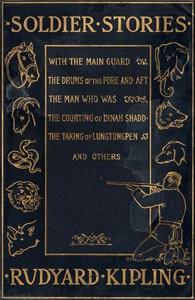
For Soldier Stories — A Closer Reading, the stored edition analysis reports 51,948 words, 3 hr 46 min estimated reading time, and 7 detected text sections.
The text analysis averages about 16.7 words per sentence, while the detected sections provide another way to judge how the source is divided.
Project Gutenberg metadata also associates the work with “Great Britain -- Social life and customs -- 19th century -- Fiction,” connecting these edition facts with the source record’s subject description.
Explore this collection
These alternatives are selected using recorded categories and estimated reading time.
About 217 minutes
Historical Psychological Social Fiction
49,723 recorded words. 9 minutes difference from this book's estimate.
View Gutenberg source #28512About 214 minutes
Historical Psychological Social Fiction
49,065 recorded words. 12 minutes difference from this book's estimate.
View Gutenberg source #24499About 257 minutes
Historical Psychological Social Fiction
59,014 recorded words. 31 minutes difference from this book's estimate.
View Gutenberg source #34280Search stored excerpts and compare books → Choose by your preferences →
Choices use stored catalog measurements. Estimates vary with reading speed. A shared category is a catalog label, not a claim that two books have the same argument or literary quality.
Search reads excerpt text stored with this catalog and links to its associated Gutenberg record. The connection is stored in the site database; this tool does not recheck that every excerpt is word-for-word identical to that external record. Excerpt search does not cover every chapter and does not verify historical publication dates.
Catalog snapshot checked: 2026-09-25. Coverage: 95 public books, 95 available source excerpts.
Read the complete public-domain text at its original source.
Read on Project GutenbergKipling's Soldier Stories opens not with a parade-ground order but with Mulvaney's complaint about the 'melancolious counthry' of India, delivered at one o'clock on a stifling June night. The setting—the main gate of Fort Amara—immediately establishes a pattern: the stories move between the claustrophobic intimacy of campfires and guardrooms and the sudden, chaotic violence of skirmishes. Mulvaney, Learoyd, and Ortheris recur across the collection, their voices distinguished by dialect and temperament. The excerpts show Kipling's ear for vernacular speech, as when Mulvaney recounts a Dublin theatre memory to explain his knowledge of Shakespeare, blending barrack-room profanity with literary allusion.
Mulvaney's Irish brogue dominates the opening story, with phrases like 'Mary, Mother av Mercy' and 'shuparfluous necessity' marking his speech as distinct from Learoyd's Yorkshire reserve and Ortheris's Cockney slang. Kipling uses dialect not merely for colour but to signal social hierarchies and regional identities within the British army. When Mulvaney quotes Polonius—'Don't fight wid ivry scutt for the pure joy av fightin''—the mangled allusion reveals his self-education and his habit of recasting high culture into barrack-room wisdom. The transcriber's note warns of 'dialect and unusual spelling,' and readers should expect to parse nonstandard orthography that slows the reading pace, forcing attention to the rhythms of spoken language.
Recurring physical details anchor the stories in sensory reality. Mulvaney complains of a blister on his heel, Ortheris pricks it with a needle, and Mulvaney later nurses his feet while warning the narrator not to slip his boots before an expected attack. The heat is oppressive: the guard is 'stripped to the waist,' and the fire at which they sit is both a source of light and an instrument of casual violence (Ortheris is 'swiftly kicked into the fire'). These small, gritty observations—blisters, sweat, cinders—ground the soldiers' bravado in bodily vulnerability, reminding the reader that these men are not abstract heroes but men with sore feet and short tempers.
Mulvaney's long anecdote about Silver's Theatre in Dublin introduces a recurring motif: soldiers as performers. He describes a production of Hamlet where the queen was 'as full as a cornucopia' and the lead actor had a black eye. The story within a story—Mulvaney heckling from the gallery, the actor threatening revenge—mirrors the structure of the collection itself, where soldiers narrate past exploits with theatrical flair. Kipling's framing device (the narrator listening to Mulvaney) turns the reader into an audience member, and the campfire becomes a stage. This self-conscious performance suggests that soldiering, like acting, involves bravado, improvisation, and the constant risk of being unmasked.
The excerpts show abrupt shifts from static conversation to action. Mulvaney's prediction of an attack—'we'll be attacked before the dawnin''—is delivered in the same casual tone as his theatre reminiscence. The narrative moves from the guardroom to the battlefield without transition, a technique that mirrors the soldiers' own experience of sudden violence interrupting long stretches of boredom. The table of contents lists stories with titles like 'The Taking of Lungtungpen' and 'The Madness of Private Ortheris,' suggesting that each piece pivots on a single dramatic event. Readers should expect swift changes in setting and tempo, with dialogue carrying the burden of exposition.
These seven stories reward attention to the spaces between action—the moments of waiting, the banter that conceals fear, the physical details that make the exotic familiar. Kipling's soldiers are neither heroes nor victims but talkers, and their talk is the real subject. Approach the collection as a series of campfire performances, each tale shaped by its teller's voice and audience.
Reading Kipling’s soldiers, I kept thinking about the weight of their boots and the way heat seems to press a story into you. That lingering, unshakeable feeling—it’s the same quiet hold What's-His-Name — A Reader’s Guide has on me, like a familiar voice in another room. What's-His-Name — A Reader’s Guide stays with you long after the page turns.
Answer a few questions and save a private reflection on this device.